

Norway’s late king lived in a palace owned by the state, summered on army land and held a fortune the court last sized in 2019; who inherits what, the palace is not saying.
HOLA told its readers in November that it would explain whether King Harald V had left a will. Then, like every Norwegian paper that has tried since September, it described a good deal of handsome property and stopped at the door of the probate office. No will has been published, and the palace has not answered Norwegian reporters who asked whether one exists or whether the settlement is finished.
What can be told is the shape of the thing. King Harald V owned some of the roofs he slept under and none of the grandest. He left a widow bound by a 1968 marriage contract, two children who had each received a house from the family long before anyone asked about his will, and a family habit of settling a king’s estate in private. Start with what was his to leave.
Did King Harald leave a will?
Nobody outside the family can say. The death itself is a matter of record. The court’s notice of 28 August says the king “fell peacefully asleep” at Rikshospitalet at 06.35 that Friday, and Al Jazeera gave his age as 89 and the cause as a rare blood condition. He had been admitted on 17 August, after cortisone given for haemolytic anaemia left him retaining fluid.
The succession took a few hours. At 11.30 the same morning his son was formally named King Haakon VIII, and his granddaughter became Kronprinsesse Ingrid Alexandra, keeping the name she already had.
A crown passes by the clock and a cabin passes by the lawyers. Their timetable has not been published.
Which of the royal houses did he actually own?
The palace keeps its own list. Under private properties it names Skaugum in Asker, Kongsseteren in Oslo, Prinsehytta in Sikkilsdalen and Mågerø on Tjøme, and it adds holiday places at Uvdal and at Flatholmen in Risør under the royal couple’s name, although other Norwegian reports file those two with the crown prince couple instead. The page now carries a warning that errors may appear on the site following the king’s death. It is the most candid line the palace has published on the subject.
The oldest provenance belongs to Prinsehytta. Crown Prince Gustaf Adolf of Sweden gave the cabin to Norway’s Crown Prince Olav on 2 July 1924, the day Olav came of age, so a Swedish heir furnished a Norwegian one with somewhere to go in the holidays, and the family has had it ever since.
Skaugum is the family’s working farm and its best bargain. According to the palace, Minister Fritz Wedel-Jarlsberg sold it to King Haakon VII in 1929 for NOK 120,000. The palace page still describes it as the crown prince couple’s, a label written before August.
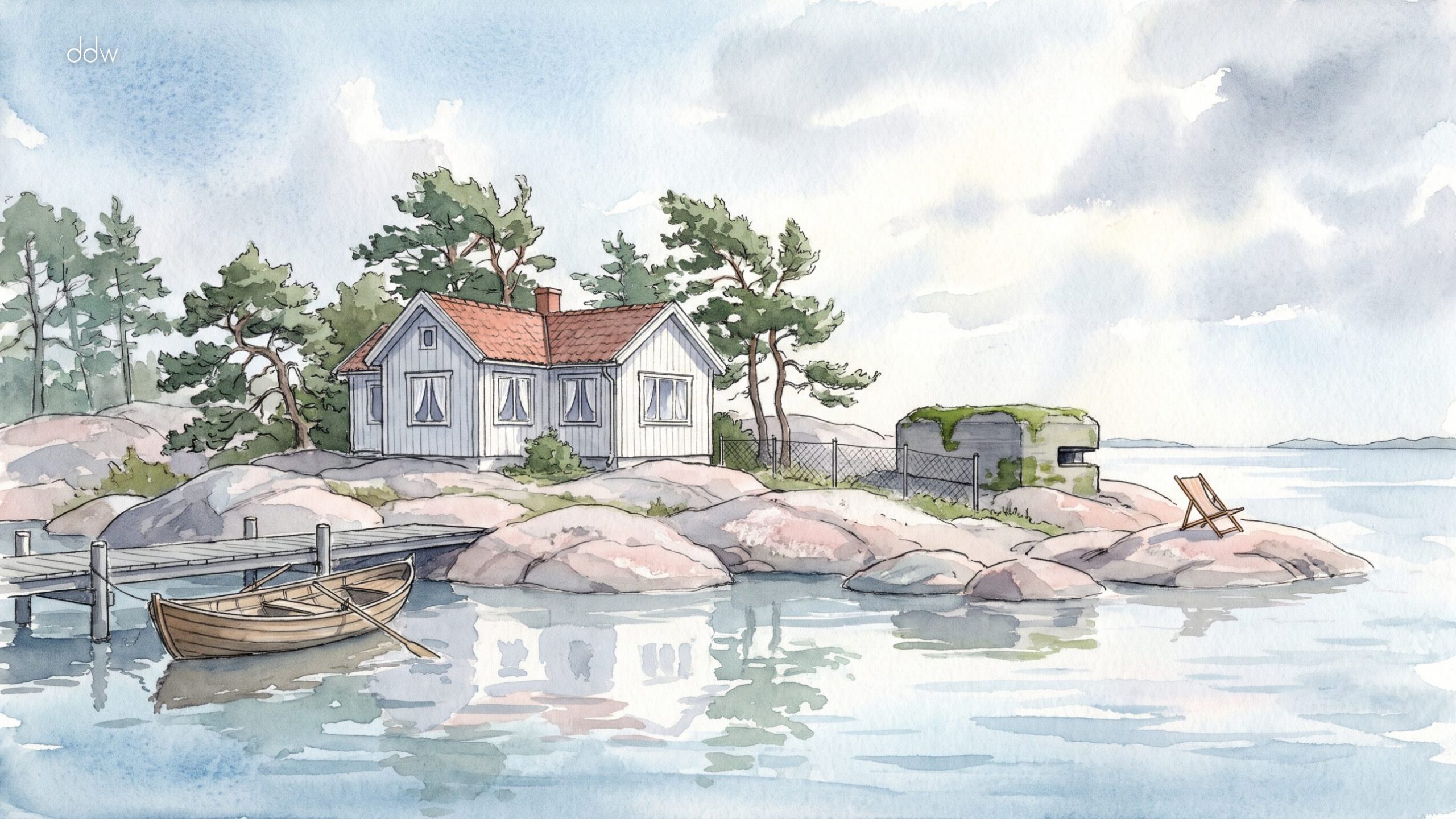
Mågerø is the summer place, on a point on Tjøme, which the king and queen could start using in 1993. In 2016 it was reported that the house stands on Armed Forces land under a ground lease between the king and the military. Whether a lease from the army passes to heirs as tidily as a freehold has not been answered in print.
Kongsseteren, above Oslo, is the one already in motion. One report has it with a new owner, without saying who or since when. When HOLA counted three royal retreats, it meant Prinsehytta, Mågerø and Kongsseteren, which is a fair list of the pretty ones and not the whole portfolio.
What stays with the crown whoever inherits?
The addresses most people picture when they think of Norwegian royalty were never Harald’s. The Royal Palace and Bygdø Kongsgård belong to the state and follow the royal title. Gamlehaugen in Bergen, which the state took over in 1925, serves as the king’s official residence in the city. They passed to Haakon VIII because he is king, they will pass to his daughter in the same way, and none of them appears in anyone’s inheritance.
Some moveables follow the same path by custom. Ole-Jørgen Schulsrud-Hansen, a historian and royal commentator quoted by Aftenposten, expects Haakon to be left the valuables that traditionally belong to the sitting monarch.
The yacht is less clear. Aftenposten counts the royal yacht among the things Harald owned, recalling that the Norwegian people gave it to Haakon VII; another account has the royal house as owner and the Navy as operator. Which version is right decides whether a ship sits in the estate or simply stays with the job.
The grandest rooms are the ones no heir can sell.
Who are the heirs under Norwegian law?
Under ordinary Norwegian law, Harald’s heirs are Queen Sonja, King Haakon and Princess Märtha Louise. Aftenposten put it with more ceremony: he leaves his two children and the enkedronning, the queen dowager.
HOLA, relying on a Norwegian celebrity weekly, gives the default split if there is no will: a quarter to Sonja and three-eighths to each child. That is what the law would do in the absence of instructions, and three things could change it: a will, the 1968 marriage contract, and a choice the widow is entitled to make. None of the three has been made public.
The arithmetic of the throne runs the other way. Ingrid Alexandra stands ahead of her younger brother, Sverre Magnus, and when she eventually reigns, Märtha Louise and her three daughters, Maud Angelica, Leah Isadora and Emma Tallulah Behn, drop out of the line of succession altogether. The crown has been narrowing around the king’s daughter for a generation. On HOLA’s reading, the law of inheritance gives her exactly what it gives her brother.
Why might Queen Sonja wait?
Because Norwegian law lets her. Harald and Sonja married in 1968 with full separate property, særeie, and according to Aftenposten the agreement left Berget as hers. That was a careful document for a crown prince marrying a commoner who sold dresses in Oslo, and it still governs who owned what in the marriage, fifty-eight years on.
The second document is one she may or may not sign. A widow can choose to sit in an undivided estate, uskiftet bo, and if Sonja does, the main settlement is postponed. Whether she has chosen it has not been reported.
Has anything already been handed down?
Yes, and well before anyone was asking. In 2001 each of the king’s children came away with a house.
Märtha Louise’s was Bloksberg, a cabin on Hankø that Crown Prince Olav had bought in 1947. According to Aftenposten, it went to her that year as an advance on her inheritance, and she sold it in 2020 for NOK 26 million. The Norwegian phrase is forskudd på arv, and the family used it with the precision of people who knew a settlement would one day follow.
Haakon’s was Skaugum. HOLA reports that Harald gave the farm to his son when Haakon married Mette-Marit in 2001, which is how the property his grandfather bought for a wedding in 1929 came to house the next royal household too. The house that began as one prince’s marriage present became another’s.
Both children, in other words, had a house from their father a quarter of a century before anyone began asking about his will.
How much money is there?
Less is known than the headlines suggest, by design. The family and the court have never wanted to give the fortune’s exact size, Aftenposten notes. The one official figure is a palace statement from 2019 putting the family’s money at about NOK 100 million, held in funds and bonds in Norway and abroad, a number E24 has repeated while noting that the palace did not answer when asked what it is worth now.
That figure is seven years old, it describes the family’s liquid money rather than one man’s estate, and it says nothing about the houses. Norwegian estate agents asked to value Mågerø and the rest have reached for much larger sums, which is easy to do for property that has never been on the market and is unlikely to be. The round dollar figures circulating in English cite nobody.
What the money buys is clearer than what it adds up to. A cabin from Sweden, a farm from 1929, a summer house on borrowed military ground: the private estate of a Norwegian king is old, rural and modest beside the state property he occupied, and most of it has been in the family long enough that putting a price on it feels faintly rude.
What happened the last time a Norwegian king died?
Harald became king on 17 January 1991, when Olav V died, and he and his sisters, Astrid and Ragnhild, went through exactly this. Olav’s estate was settled the following year by a private probate court, which put it at NOK 110–130 million and divided it among the three siblings. No will was read on the palace steps and no inventory was published.
Norwegian reports now say Harald’s settlement is under way, and that some of the private properties have already changed hands. The palace has added nothing. Last time, the only figure anyone saw came the following year, from a court, as a range.
Read Next: King Harald V Gave Norway Its First Queen Since 1938