


A Nickel for Inaccuracy
The penalty for an untidy account book was five cents. Exceptional accuracy or neatness earned five cents back, and the examiner, once a week, was the only son of the man who built Standard Oil.
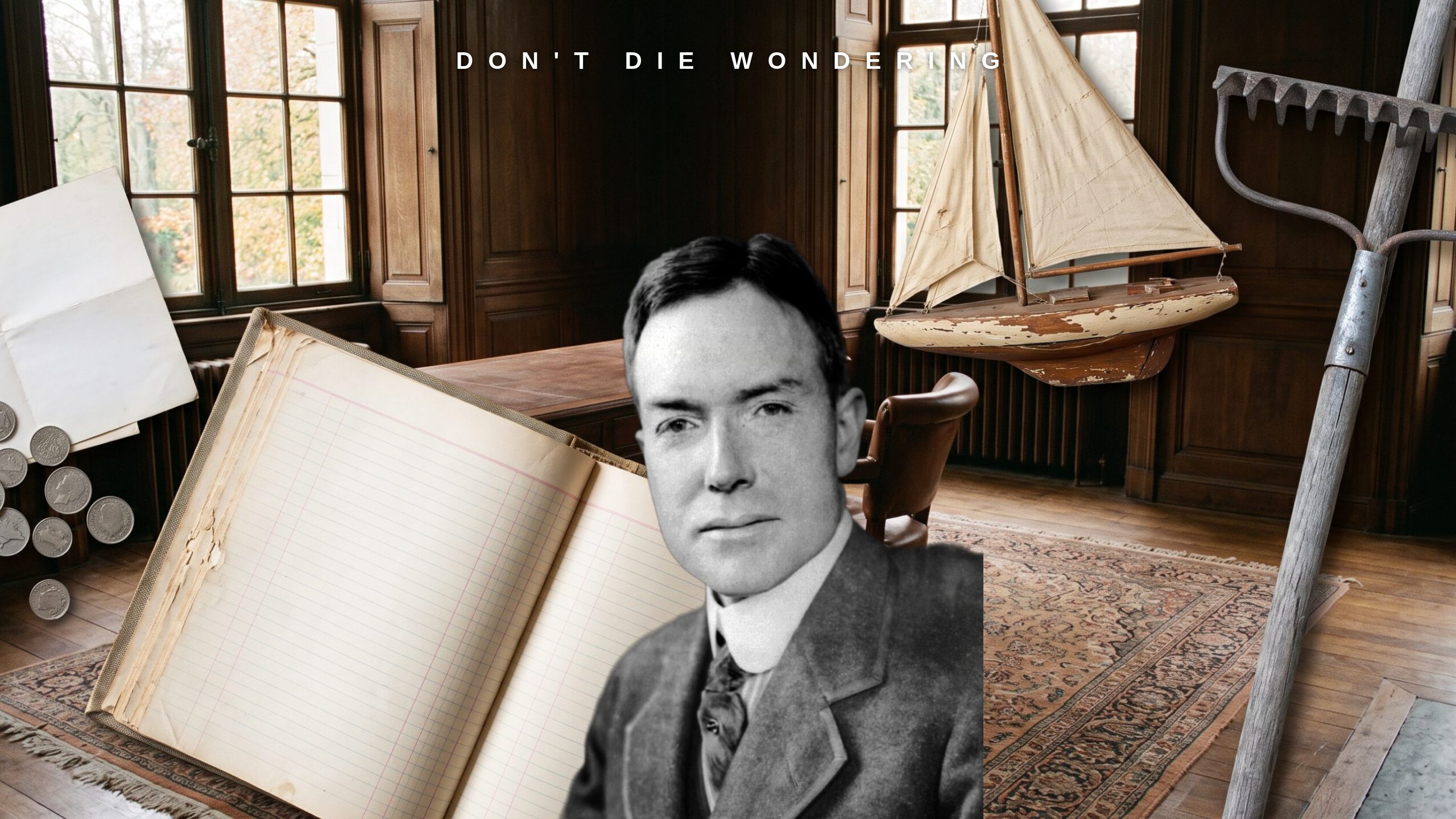
David Rockefeller, the youngest of the six children, received twenty-five cents a week and was obliged to track every outgoing in an account book that his father checked over weekly, according to TIME’s profile of him as Chase chairman. The same account records that at seven he spent eight hours raking leaves on the grounds at Pocantico Hills to earn two dollars. Soon after his tenth birthday he decided he wanted a toy sailboat and commissioned one himself from a carpenter. When his father found out, the four dollars came off his allowance, spread over months.
Adjusted for anything you like, four dollars was not the point. The deduction was the lesson.
“Father never allowed us to feel that we would ever have unlimited sums of money,” David told TIME, in the same 1960s account of his upbringing. He was, at the time, running one of the largest banks in the world.
Memorandum Between Papa and John
The system had a paper trail, and it reads like a term sheet. On 1 May 1920, the 46-year-old John D. Rockefeller Jr. executed a document headed “Memorandum between PAPA and JOHN, Regarding an Allowance” with his 14-year-old second child, John D. Rockefeller III, later chairman of the Rockefeller Foundation.
The terms, reproduced by Smithsonian magazine, set the allowance at one dollar and fifty cents a week. At the end of each week in which John had kept his accounts accurately and to Papa’s satisfaction, the following week’s allowance rose by ten cents, to a ceiling of two dollars. Each week in which he had not, it fell by ten cents. There was an upside clause too: on any savings deposited in his bank account above the twenty per cent specified in Item No. 8, Papa would add an equal sum.
A matched contribution, a performance ratchet, a capped upside and a clawback, all of it administered on a boy whose weekly ceiling was two dollars. The clauses, as in any term sheet, were numbered.
John III had been in the system for six years by then. The allowance started at ten cents a week when he was eight, and from the beginning he was required to keep a journal and to discuss the use of his money with his father, per EBSCO’s biographical record of his life.
Eight Hours of Leaves at Pocantico
The allowance was only the base salary. The children were paid for household chores, among them shining shoes, catching mice and growing vegetables, and cooking dinner was their responsibility once a week, according to PBS’s American Experience account of the family. Figures circulate online for the per-mouse and per-fly rates; none of them could be tied to the family’s own papers in our sourcing, so they are not reproduced here.
What survives reliably is the shape of it. Six children of enormous wealth, living in a house where you earned your money, wrote down where it went, and then sat with your father while he read the column.
The historian Clarice Stasz, interviewed for the PBS documentary, put the motive in the parents rather than the children. Her reading was that John Jr. and Abby were a little frightened of the fortune, that they wanted the household to go on as it had before, with plain clothes and shared toys and children earning their allowances, and that they regarded this as the machinery of character.
Junior said it more plainly, in the line PBS attributes to him: “I was always afraid money would spoil my children, and I wanted them to know its value and not to waste it.” It is the only traceable attribution for the remark, which is worth knowing before anyone carves it into a wall.
Ten Per Cent, or a Third
Here the record splits, and it is more interesting than a tidy version would be.
David Rockefeller, describing the rule to TIME in his own words, said his father’s strict rule was that the children should save ten per cent of their money and give away ten per cent. PBS’s biography of Junior states something considerably harsher: that the children could spend only a third of what they earned, with the other two thirds donated and saved.
Both cannot be the household rule for all six children at all times. Neither has been matched, in this reporting, to an original document in the family’s own archive. It may be that the terms tightened or loosened across twelve years of births, from Abby in 1903 to David in 1915, or that each child was negotiated with separately, as the 1920 memorandum rather suggests. Whether Babs, the only daughter, was held to the same arithmetic as her five brothers is not addressed in any source consulted.
What is not in dispute is the structure. Some of it was yours, some of it was the bank’s, some of it was the church’s, and all of it was written down.
$537 Million and a Family Credo
The father doing the auditing was not frugal in any ordinary sense. His charitable gifts over a lifetime are estimated at $537 million, according to PBS’s biography, spread across foundations, churches, historic preservation, universities, parks and museums, in that order. In 1948 he sold Rockefeller Center to his five sons. The price has not been published in anything we could verify, so it is not given here.
The credo cut into stone at Rockefeller Center runs on the same logic as the account books: every right implying a responsibility, every opportunity an obligation, every possession a duty. The boy who lost four dollars over a sailboat grew up reading his father’s sentences in granite.
What the Cousins Let Slide
By the third generation, the ritual had acquired a degree of theatre. David Rockefeller Jr., recalling it for the PBS documentary, described allowances handed out on Sundays, strategically just before church, with a portion going straight back out and an accounting to follow. Then came the admission, delivered in the same film: “with some of my sisters, it became kind of a game to see how skilfully you could invent the previous week’s expenditures.”
He also told CNBC that he gave to charity out of his very first allowance at the age of ten, which is the same pattern his great-grandfather set by tithing his first pay packet. His view, given to the same interviewer, was that the words would have counted for nothing if the values had not been lived.
The ledgers that had regulated three generations of Rockefellers were all but abandoned by the time the Cousins came of age, PBS’s narration states. More than 250 direct descendants of John D. Rockefeller and Laura Spelman Rockefeller were alive when CNBC published that figure in 2018.
David Rockefeller, the last of the six children who had been audited every week, died at his Pocantico Hills home on 20 March 2017, aged 101. Fortune reported his fortune, real estate, share of family trusts and other holdings at an estimated $3.3 billion, citing Forbes, and his spokesman put his lifetime giving at nearly $2 billion.
In 1974, the children of John D. Rockefeller Jr. established the Rockefeller Archive Center to gather their family’s records into one institution. The account books went in with them.
Cover photograph: Underwood & Underwood via Wikimedia Commons (Public domain).