


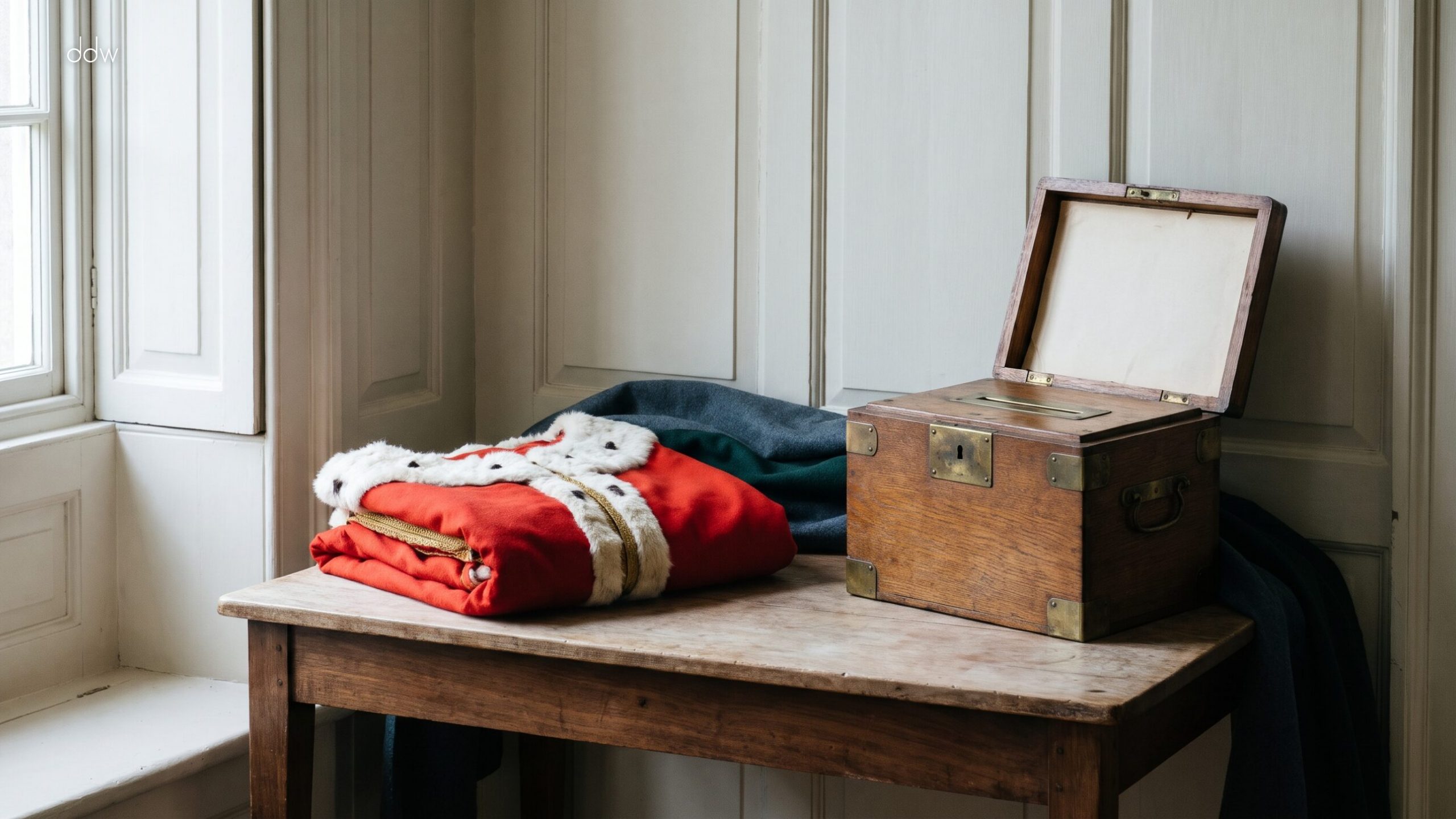
Parliament removed the only members of the House of Lords who had won their seats in a vote, left every one of their titles intact, and within a fortnight began announcing life peerages for many of them.
Reformers have long complained that the House of Lords is filled by patronage. The House of Lords (Hereditary Peers) Act 2026 answered that complaint by removing the only members who reached the chamber through an election. Royal Assent came on 18 March 2026, and the hereditary right to sit lapsed when the session ended on 29 April. On that day, 76 excepted hereditary peers eligible to sit, and one on leave of absence, left the Lords, according to the House of Commons Library. The famous 92 is the number of seats the 1999 settlement kept for hereditary peers. It was never the number of people still sitting at the end, and anyone who tells you 92 people were thrown out has counted the chairs rather than the occupants.
Hereditary peers were the only members of the Lords who won their seats in an election
After 1999, according to the House of Commons Library, hereditary peers could stand for 90 “excepted” places, and the Earl Marshal and the Lord Great Chamberlain sat by virtue of their offices. From 2002, the Lords Library records, vacancies among the excepted peers were filled by by-election, until the House paused the contests in July 2024. The electorate was their fellow peers, which is narrow by any standard. It was still wider than the electorate for every other seat on the red benches, because for those seats nobody votes at all. Critics enjoyed mocking these by-elections, and the mockery was fair as far as it went. A small electorate is a poor thing, but it is more than none.
Removing them left a House of Lords in which nobody is elected
On 13 September 2024, the House of Commons Library counted 88 hereditary peers eligible to sit, alongside 692 life peers and 25 bishops. Since the session closed, the same library notes, the chamber has consisted only of life peers and the Lords Spiritual. Bishops come with their office and life peers come by appointment. Neither group arrives by vote. Strictly, the House is not “wholly appointed” in one uniform way, because the bishops have their own route in. The argument still holds: every member now owes the seat to someone else’s decision. The case against the old House was that it was a house of favour, and this reform has made that true of every member. Patronage now has a full house.
Their independence was relative, and it was still worth having
The Lords Library put the sitting hereditary peers at 81, about 11 per cent of the House. Around half sat as Conservatives and over a third as Crossbenchers. Any defence that casts them as a bench of saintly neutrals falls at the first division list. They sat in party groups, and they stood in by-elections organised along party lines. The honest claim is narrower, and it is enough. None of them owed the seat to a whip, a donor or a prime minister’s list, which is more than can be said of anyone appointed in their place. A Crossbencher who inherited his chance and then won his place had no one to thank but an electorate of peers. That is a modest kind of independence, and it was the only kind on offer.
Twenty-six of them were back as life peers within a fortnight
The life peerages for former excepted hereditary peers were announced on 12 May 2026, according to the House of Lords Library, in addition to three granted before the Act came into force. The Lords Library table shows Viscount Goschen, a Conservative who had sat for 37 years and nine months as a hereditary member, returning as Lord Hawkhurst. Hosts drawing up a placement this winter will need to remember the new name, since the old one did not stop being his. Lord Cromwell, Lord Grantchester, Lord Londesborough and Lord Russell of Liverpool were all excluded in 1999, came back through by-elections, were removed again in April and have now been readmitted by appointment. The list ran across Conservative, Crossbench and Labour members. If the principle was that these individuals had no business in Parliament, re-appointing them is an odd way to show it. What the government actually changed was the route in. It kept the people and swapped the defensible route for the less defensible one.
Every title survives, and only the seat has gone
The Act deals with membership of the House and with claims to hereditary peerages, the House of Commons Library notes. It leaves the peerage itself alone. A viscount remains a viscount, the title passes by inheritance as before, and the form of address on the envelope is unchanged. Section 3 abolished the Lords’ jurisdiction over claims to hereditary peerages. The last claim considered by a Lords committee was Lord Moynihan’s, in March 1997, and the Lords Library table shows that, after 29 years as a hereditary member, he has returned as Lord Moynihan of Purbeck. He therefore had the last peerage claim the House heard and was among the first members to be reappointed. For the aristocracy more broadly, hereditary rank in Britain now carries on wherever it was never asked to legislate. In the Lords, the decorative part of inherited rank was kept and the working part was taken away.
Birth is a poor qualification for lawmaking, and the honest defence admits it
Baroness Smith of Basildon, the Leader of the Lords, said the Act was never about the contributions of individuals. She said it rested on the principle that no one should sit in Parliament by way of an inherited title. Labour’s 2024 manifesto, as Full Fact records, promised to remove the right of hereditary peers to sit and vote. The bill, introduced in the Commons on 5 September 2024, set out in its long title to remove “the remaining connection between the hereditary peerage and membership of the House of Lords”, wording the House of Commons Library briefing reproduces. On the principle, the government is right. Being the eldest surviving son of a man who was himself an eldest surviving son tells you nothing about a person’s grasp of the Finance Bill. Since the 1999 compromise, however, birth had only made a person eligible to stand, and election did the choosing. The system that replaces it also turns on an accident, the accident of being noticed by whoever draws up the list. Birth is a bad reason to sit in Parliament, but it is a fairly good reason to owe Parliament nothing.
The Lords offered a compromise and then conceded without a division
At report stage in July 2025, the Lords voted to let current hereditary peers keep their seats while ending by-elections. That would have ended the hereditary bench gradually, through retirement and death, without removing anyone. The Commons rejected the change and the Lords did not press it. At the final stage of ping-pong on 10 March 2026, Parliament records, the Lords accepted the Commons’ reasons without a division. On that day, the Lords Library counted 85 excepted hereditary peers holding seats, and four retired before the session ended. The Act that removed them is short, with six sections, the New Law Journal notes. The same journal reports that the debates raised unresolved questions about retirement ages, attendance requirements and the bishops, and that the government signalled further reform would probably proceed step by step. Removing the one elected element before deciding what the second chamber is for amounts to vandalism dressed as reform. The questions about retirement ages, attendance and the bishops, which might have improved the House, were left for later.
The obvious follow-up question is whether a hereditary peer can ever sit in the Lords again. The answer is yes, but only as a life peer, appointed in the same way as everyone else, as three were before the Act came into force and the May list showed for many more after it. The title still passes by birth. The seat is now in someone’s gift.