


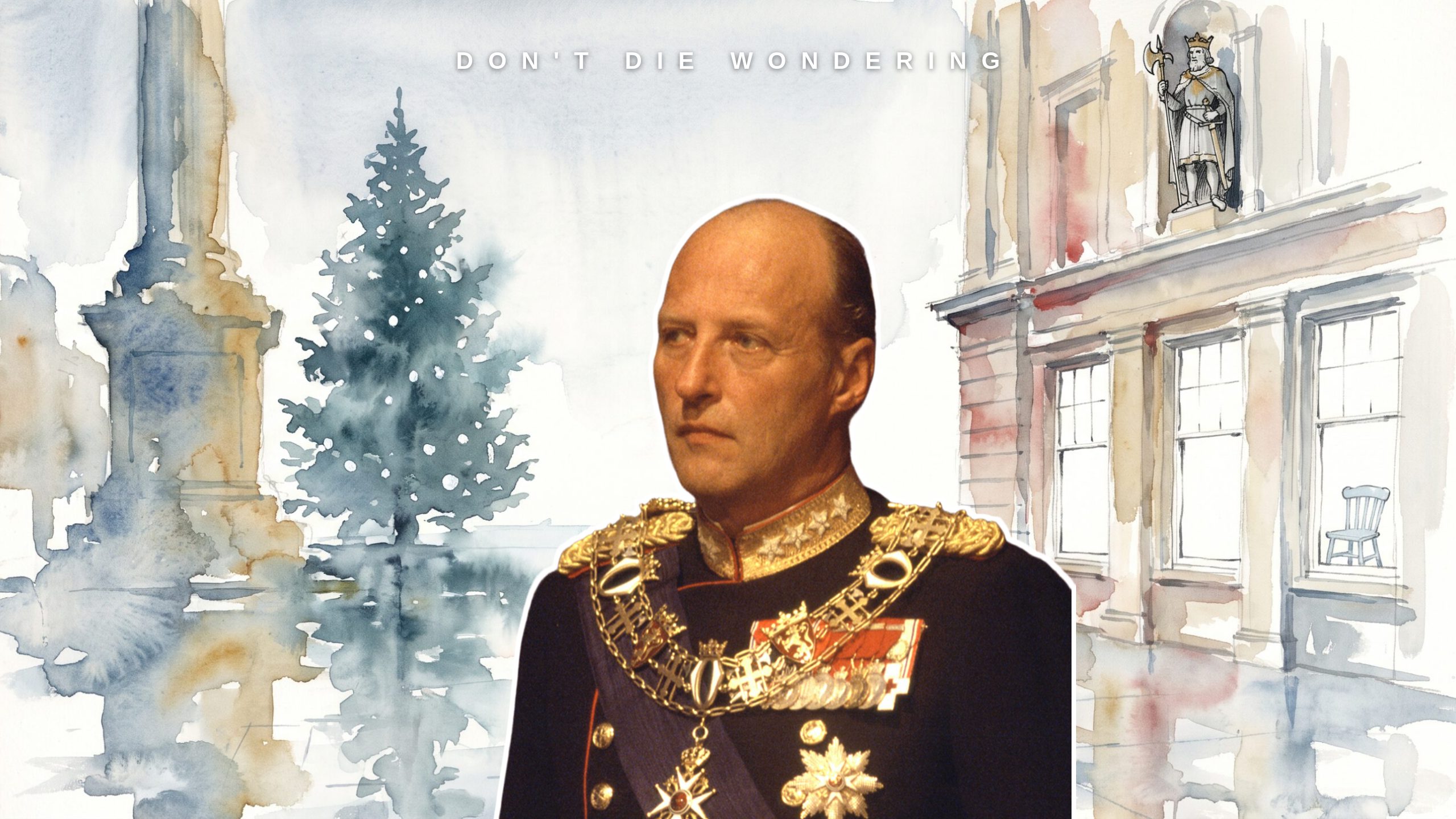
Thirty-five years on the throne, nine days lying in state, a private grave at Akershus. Then, days later in London, a flat under a gilded St Olaf at £2.95m, with no seller named.
Harald V married Sonja Haraldsen in 1968. Twenty-three years later, on 17 January 1991, he became King of Norway and she became the first queen consort the country had had since Maud of Wales, who died in 1938. Fifty-three years is a long time for a nation to leave a role vacant, and a long time to be married before anyone has to curtsey to your wife.
He was born at Skaugum, in Asker, on 21 February 1937, into the House of Glücksburg. He reigned for 35 years. He was admitted to Oslo University Hospital Rikshospitalet on 17 August 2026 and died there at 06:35 on 28 August, aged 89.
Sonja Haraldsen and the Shape of a Reign
The marriage is the fact everything else in his life arranges itself around, because it was the choice that decided what kind of monarchy Norway would have. A Haraldsen became queen. The House of Glücksburg, imported from Denmark, acquired a surname that sounds like a phone book.
Norwegian royalty since has been measured against that register: small, domestic, correct. Queen Sonja keeps her title after his death. She held the job for 35 years and nobody has ever had to explain her.
Eleven Days at Rikshospitalet
The end was documented to the minute. Eleven days in hospital, then 06:35 on a Friday morning in Oslo, and a succession that took effect in the same breath.
He lay in state at the Slottskapellet, the chapel inside the royal palace, from 31 August to 8 September: nine days, indoors, with the queue and the rain kept at a Scandinavian remove. The state funeral was held on 9 September at Oslo Cathedral. Then a procession to Akershus Fortress and a private interment in the Royal Mausoleum, where the family has been putting its kings for a century.
Public to the last morning, private by the afternoon. Norway has always been good at that trick.
A Government That Ran Norway From a London Address
The wartime story belongs to his grandfather. After Germany invaded Norway in 1940, King Haakon VII and the Norwegian government fled to Britain and set up a government-in-exile in London. Harald was three years old at the time, which is a useful thing to hold on to when the internet starts attaching the wrong king to the right building.
The building is Norway House, on Trafalgar Square. According to Robb Report, it was completed in 1914, and its identity took shape in the 1920s when it became home to the Norwegian Chamber of Commerce. A gilded statue of St Olaf, the medieval Norwegian king who became the country’s patron saint, was added to the facade, along with a Norwegian heraldic shield and other decorative details. During the war years the address housed several Norwegian organisations and government offices, and the king and other government officials were among its visitors.
That is the tie, and it is worth stating precisely: institutional and architectural, via Haakon VII. No available source describes the Norwegian crown, King Harald’s estate or the current royal family as owning, having owned or profiting from the building or any flat in it.
There is one more piece of the same era still visible from the pavement. In 1947 Oslo gave London its first Christmas tree as thanks for Britain’s support during the war, and nearly 80 years later the tree still makes the trip to Trafalgar Square each December.
1,427 Square Feet Above Trafalgar Square
Around 10 September 2026, Robb Report reported that a three-bedroom apartment in Norway House had come to market at £2.95m, roughly $4m, with Becky Fatemi’s team at UK Sotheby’s International Realty. The price and the agency details currently trace back to that reporting and its syndication, and have not been independently confirmed elsewhere.

What the listing offers, per the same coverage: 1,427 square feet, three bedrooms, two marble bathrooms, a pale-blue kitchen, and a reception and dining area with a view over the square where the tree goes up.
> “You have beautifully refurbished lateral space, an almost 38-foot reception room, and these extraordinary views across Trafalgar Square,” says Thomas Brooks, director of sales at UK Sotheby’s International Realty.
No source names the seller or the current owner. No source establishes when the flat first went live as opposed to when the coverage ran, and nobody has claimed the timing against a state funeral was anything other than a coincidence of the calendar. The correct reading is the dull one: a refurbished lateral flat in a listed-looking Edwardian pile with a saint on the front, priced at a level that would buy considerably less square footage four streets west.
For scale, Norwegian money in London runs to other magnitudes entirely. John Fredriksen’s Old Church Street residence has been valued at up to £250m. That is a separate house, a separate fortune and no relation to any of this.
Haakon VIII, 53, and Ingrid Alexandra, 22
The son inherited at an age when most heirs are still described as the future. Crown Prince Haakon, born 20 July 1973, became King Haakon VIII on his father’s death at 53, the second child and only son of Harald and Sonja. He married Mette-Marit Tjessem Høiby, born in Kristiansand in 1973, in 2001.
Their daughter, Crown Princess Ingrid Alexandra, 22, is now heir to the throne and, as Hello reported, is set to become only the second queen regnant in Norwegian history. Her brother, Prince Sverre Magnus, born 3 December 2005, is second in line. The line is young, small and unambiguous, which is the version of dynasty that survives the century.
The new reign begins with a live legal matter attached to it. Hello reported that Queen Mette-Marit’s standing has been clouded by controversy over her links to Jeffrey Epstein and over the conviction of her eldest son, Marius Borg Høiby, born 13 January 1997, who holds no royal title. The court record is the part that is settled: Høiby was convicted of rape, abuse in close relationships, assault, drug possession and supply, and restraining order violations, and sentenced to four years’ imprisonment.
Harald reigned for 35 years without anything of that order arriving on the palace’s doorstep. His son inherited the throne and the file on the same Friday morning.
St Olaf, Still Gilded
What the estate of Harald V actually consists of has not been published. No net-worth figure for the king or for the Norwegian royal family appears in the coverage of his death, which is itself a kind of statement of intent from a monarchy that spent 35 years declining to be interesting about money.
So the only Norwegian royal asset with a price on it this month is a flat that nobody has connected to the family, in a building his grandfather’s officials used while the country was being run from someone else’s capital. Its provenance is a facade: a saint in gilt, a heraldic shield, a 38-foot reception room and a window onto the square that gets the tree.
The crest stays on the building.
Cover photograph: Harry Johansen / Sámediggi Sametinget via Wikimedia Commons (CC BY 2.0).