

One woman kept the list of who mattered in New York, another threw a ball to get on it, and HBO has now reached a fourth season of the argument between them.
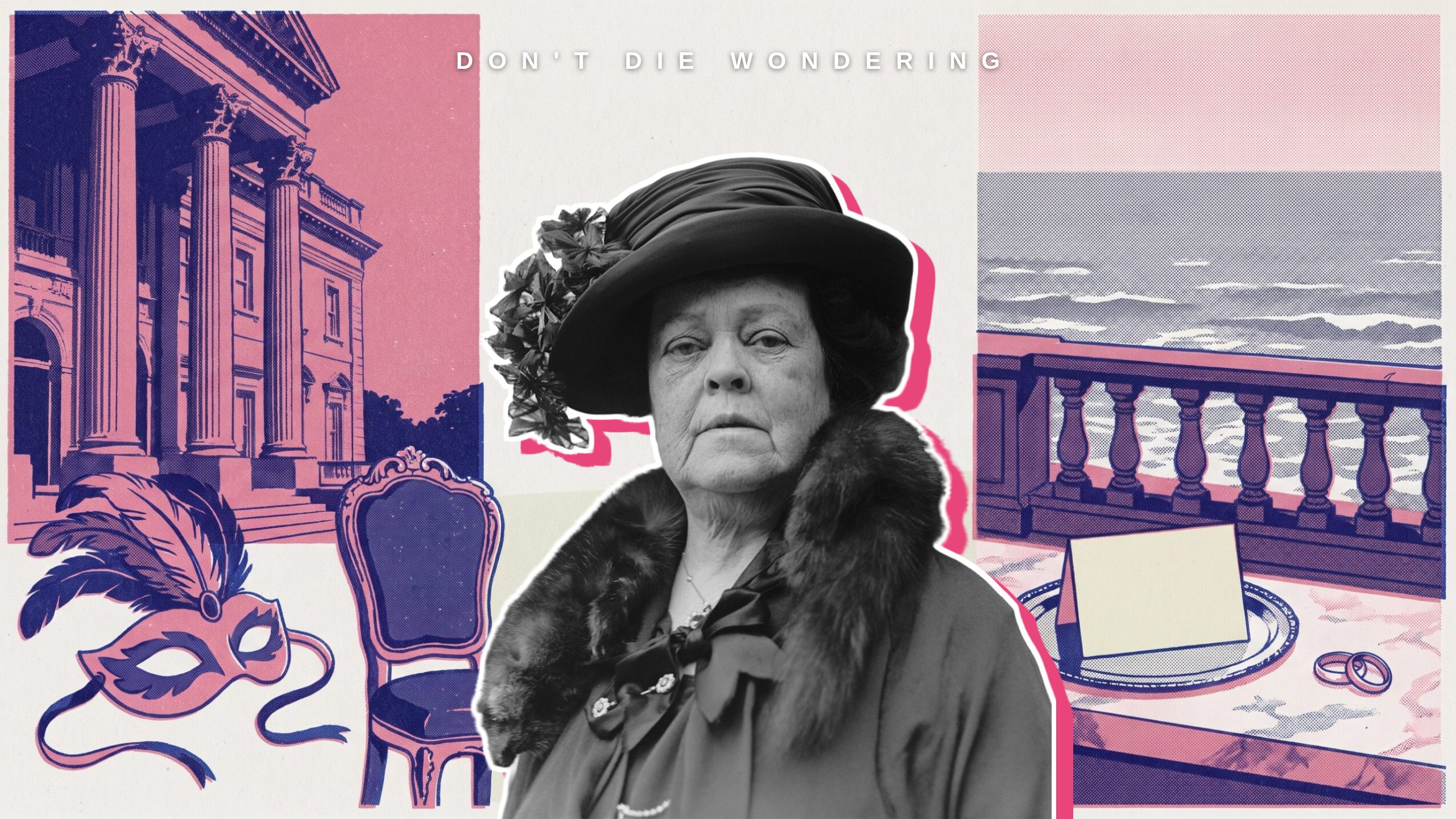
Caroline Astor was known simply as Mrs Astor, and in New York that definite article was worth more than a railway. Alva Vanderbilt had the railway, or had married into it. Her husband was William K. Vanderbilt, grandson of Commodore Cornelius Vanderbilt, who built the family fortune in steamships and the New York Central. What she lacked was the article. Her campaign to get it, conducted in three moves, is now the backbone of HBO’s The Gilded Age, which came back for a fourth season on 1 November.
1880
The board was laid out that summer in Newport. The Newport Casino opened on 26 July as a social club for the summer elite, which gave the people who mattered somewhere to spend the season looking at one another.
In town, the question of who mattered had one answer. Caroline Astor, born a Schermerhorn and married to William Backhouse Astor Jr, decided it, and her list became the Four Hundred. The usual explanation is that four hundred was the number her ballroom could hold, and E! calls that “allegedly” the origin, which is roughly how a good story survives a fact-checker.
Her adjutant in these matters was Ward McAllister, whom E! describes as her right hand and a distant relation. He also guided the newly rich through the drawing rooms of the established families. In other words, he was a broker with clients on both sides of the deal, and he seems to have found nothing awkward in that.
1883
Move one was a party. Alva’s costume ball that year helped secure the Vanderbilts’ place in high society. The Commonwealth Museum in Massachusetts, which gives the evening a page in its online suffrage exhibit, says it reportedly cost $3m for 1,000 guests. For that money she got more than a good night. She got onto the agenda.
The door she needed was opened from the inside. According to Screen Rant, Mrs Astor’s daughter Carrie shook up the Four Hundred by urging her mother to invite Alva to her parties. The Tab says Mrs Astor eventually accepted her into the circle.
Old money tends to surrender to its children first.
1888 to 1892
Move two was a house. Marble House went up in Newport over these years, designed by Richard Morris Hunt on the model of the Petit Trianon, and William gave it to Alva on her 39th birthday. The Preservation Society of Newport County puts the cost at about $11m, the figure “reported in contemporary press accounts”. Most of that went on 500,000 cubic feet of marble. In Newport, such a building is called a cottage, and nobody laughs.
McAllister, meanwhile, was getting restless. In 1890 he published Society as I Have Found It, a title that manages to sound modest and menacing at once. The show has him falling out with the socialites for leaking stories to the press and then for the book itself. That is Julian Fellowes’s version of events. The publication date belongs to history.
In 1892 William Backhouse Astor Jr died. The tell-all and the widowhood landed within two years of each other, and New York society had to absorb both.
March 1895
Move three was the exit. Alva and William announced their divorce that month, and Rhode Tour, the Rhode Island history project, records a settlement of $10m plus Marble House and several estates. The birthday present came with her. She would later be known as Alva Belmont, a surname that suggests she had not finished with marriage either.
It takes a particular nerve to leave a family on better terms than you joined it. By the account Rhode Tour gives, Alva had that nerve to spare.
1933 to 1963
Alva died in 1933, and according to Rhode Tour her funeral was conducted entirely by women, a final seating plan as deliberate as anything she arranged in 1883.
The house outlived the argument. The Preservation Society acquired Marble House from the Prince estate in 1963, and it was made a National Historic Landmark in 2006. The marble that was meant to impress the Four Hundred now has a much larger audience, and nobody’s invitation depends on who their grandmother was.
1 November 2026
Fellowes is the creator, writer and executive producer of the HBO and Universal Television co-production, with Sonja Warfield as writer and executive producer and Erica Dunbar as historical consultant, as Deadline sets out. Season four runs to eight episodes. The first, “Ring the Bells”, picks the story up nine months after the end of season three.

The fictional families stand on real foundations, without being copies. The Tab calls Carrie Coon’s Bertha Russell fictional but heavily inspired by Alva, and E! says Christine Baranski’s Agnes van Rhijn was inspired in part by Mrs Astor. The Tab also links Gladys Russell to Consuelo Vanderbilt, Alva’s daughter, who married the Duke of Marlborough. Gladys gets a fictional dukedom of her own. The real Mrs Astor is played by Donna Murphy, Carrie Astor by Amy Forsyth, and Ward McAllister by Nathan Lane, who has every line a man with clients on both sides could want.
The guest list keeps growing. JP Morgan arrived last season as a possible business partner for George Russell. This season brings John D. Rockefeller, and President Cleveland comes to New York for a dinner that Agnes hosts in his honour. Mrs Astor, who ran her evenings on the principle that some people did not get in, would have recognised the move at once.
The Rhode Island Film & Television Office announced in April that filming would return to Newport’s mansions and streets, where the houses stand in for New York interiors and an English estate. Newport’s cottages were built so that New York would notice them. Now they play New York for a living.
Read Next: Ray-Ban’s Founder Was Too Fair to His Heirs
Cover photograph: Adam Cuerden via Wikimedia Commons (Public domain).