


Conrad Hilton paid $225,000 for it, two later buyers set American records with it, a widow fought in court to keep it, and a company linked to Peter Thiel took it at auction for barely half the asking price.
By Parade’s arithmetic, the $130 million paid for Casa Encantada at a foreclosure auction in July 2026 is worth less, adjusted for inflation, than the $94 million Gary and Karen Winnick agreed for the same house in 2000.
The price history falls into two columns. One holds what buyers actually paid, in 1950, 1980, 2000 and 2026. The other holds what sellers hoped for, in 2019, 2023 and the cuts that followed. All figures are in US dollars as paid or asked at the time. The only adjusted sum is Parade’s, for the first sale.
The last name on the list arrived late. On 29 September 2026 the Wall Street Journal reported that the winning bidder in Pomona was a limited liability company linked to Peter Thiel, citing people familiar with the situation. The Real Deal carried the Journal’s account, which also reported that the buyer’s identity had been kept quiet for more than two months after the gavel fell.
$225,000
Every great Los Angeles house has a founder who lost money on it, and Casa Encantada’s was Hilda Weber. ArchUp describes her as the widow of a millionaire glassmaker who commissioned the house from the architect James Dolena in the late 1930s. Parade says she spent her fortune on it and sold at a loss, which makes her the first in a long line of owners for whom the house cost more than it returned.
The man who bought it in 1950 was in the hospitality business and knew a good room when he saw one. Conrad Hilton paid $225,000, which Parade puts at about $3.1 million in 2026 money, and he lived there until his death in 1979. Twenty-nine years is the longest tenancy on this list by some distance. It is also the only one that ended without a sale under pressure, a record dispute or a court of appeal.
Hilton gave the place its motto.
“The House Where Dreams Come True.”
Hotel men are professionally optimistic about property. This one held his purchase until the end.
$12.4m
After Hilton died, the house went to David Murdock, described by Robb Report as the retired chairman of Dole Food Products, for $12.4 million in 1980. Yahoo Lifestyle reports it was a national price record at the time, the most anyone had paid for a private home in the United States.
The figure is a multiple of fifty-five on Hilton’s $225,000 across three decades. The more useful thing it reveals is how few people in America were then in a position to pay it. A record set by a single buyer is less a market than a conversation between two families and their lawyers.
Murdock entertained in it. In 1988 he hosted a fundraising luncheon there for President George H.W. Bush, and among the guests, by his own later account to Mansion Global, was a financier named Gary Winnick. Winnick said that lunch was his first visit to the house. Twelve years later he owned it, which is a longer courtship than most marriages in the 90077 postcode.
$94m
The second record came in 2000, when Murdock sold the estate to Gary and Karen Winnick for $94 million. Yahoo Lifestyle again lists it as the most expensive private home sold in the US at the time, the second time the house had set that national record.
The headline number is less straightforward than it looks. Robb Report describes the $94 million deal as a non-standard sale involving cash and two large pieces of land. Part of the price, in other words, was paid in acreage rather than dollars, and nobody outside the deal has published how the two were divided. The $94 million is real as a record, but it is softer as a cheque.
Winnick was the founder and chairman of Global Crossing, the company that built a fibre-optic cable network. He and Karen then spent tens of millions more restoring the house with the architect and interior designer Peter Marino, according to Robb Report. The house as sold in 2026 is largely the house they restored.
Gary Winnick died in 2023.
$250m
The two Winnick-era asking prices are the most quoted figures in the story and the only ones nobody paid. The house first went up in 2019 at $225 million, a figure Fortune ran in its headline on 17 October that year and The Real Deal has since repeated. In 2023, the year Gary Winnick died, Mansion Global reported the house back on the market at $250 million, a potentially record-setting ask.
Then the descent. The New York Post reported the price had fallen to $190 million and then to $170 million, as The Real Deal recorded in February 2026, by which point Karen Winnick was trying to sell the house herself while fighting its lender in court.
An asking price is a wish with a brokerage attached. The $250 million never described what the house was worth on any particular day. It described what one family needed it to be worth, which, by 2023, was a different question altogether.
$150m
The number that sold the house was not on any listing. In 2020, according to Wall Street Journal reporting, an entity tied to the Winnicks borrowed $100 million from CIM Group’s lending arm, CIM Real Estate Credit. The borrower fell behind, and by the time of the foreclosure The Real Deal reported that entities tied to Gary Winnick had defaulted on more than $150 million in loans backed by the Bel-Air mansion and other properties. The Journal reported that the security included a Winnick family home in Malibu.
Karen Winnick and her son, Alexander, have alleged in their dispute with the lender that they were left “effectively destitute” by what they describe as a loan-to-own arrangement, as The Real Deal reported, citing the New York Post. CIM has rejected their claims of fraud and financial elder abuse, calling the family’s allegations “fantastical” in court papers, as reported in coverage of the sale, and has cast the loan as a hard-headed commercial deal between experienced parties.
The first foreclosure auction was set for 16 December 2025 in Pomona. That same day, a lawyer for Karen Winnick told the New York Post, the California Court of Appeal granted a temporary stay.
The stay held for a winter. By July, the sale had gone ahead.
$130m
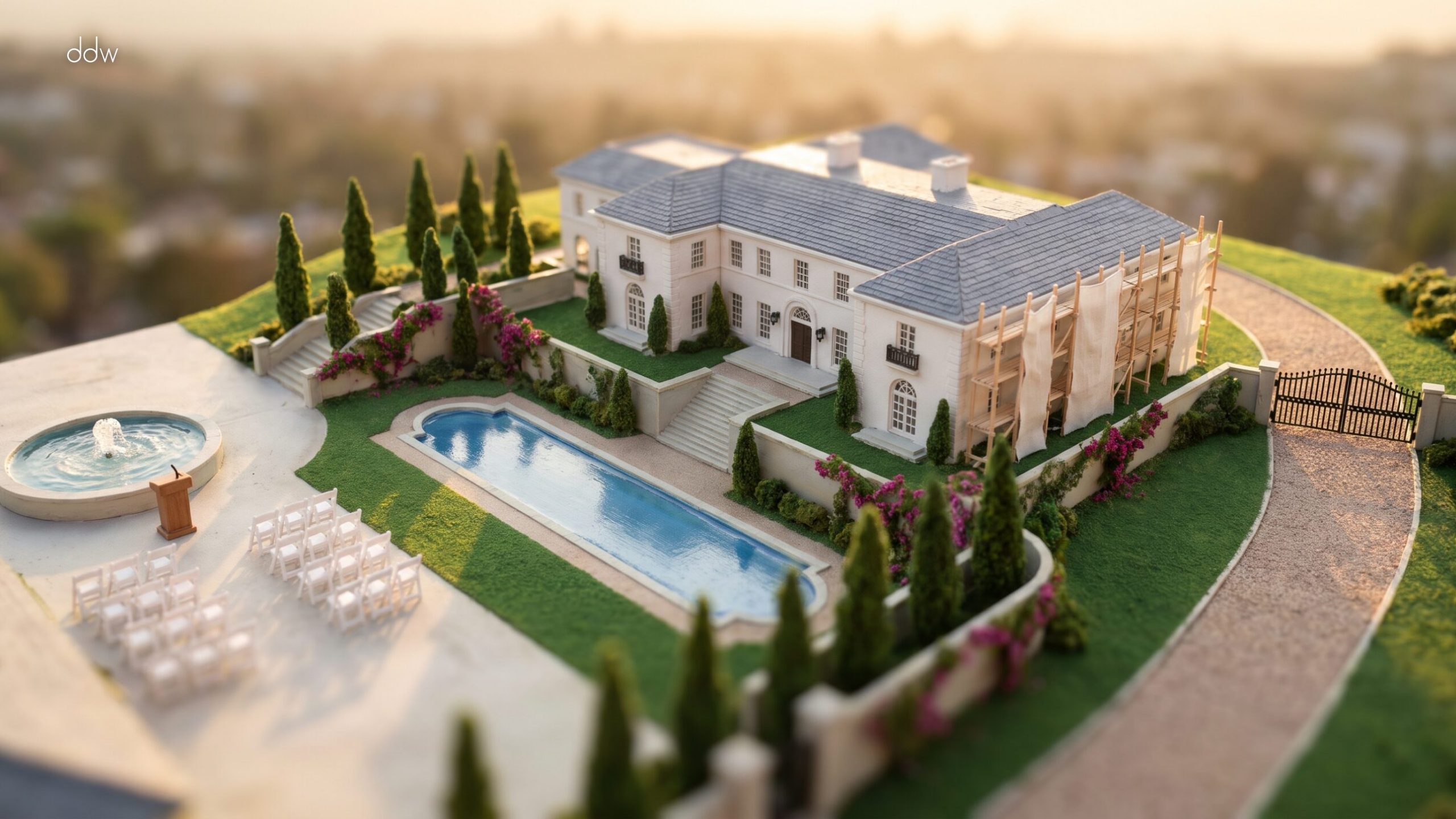
Casa Encantada finally changed hands in July 2026 at an open-air auction beside a fountain at Pomona’s Civic Center Plaza, about as far from Bellagio Road in spirit as Los Angeles County allows. The price was $130 million. Parade points out that this is just over half the $250 million asking price and, adjusted for inflation, less than the Winnicks paid a quarter of a century earlier.
The winning bidder, as the Journal reported in September, was a limited liability company linked to Peter Thiel. Yahoo Lifestyle reports he had been watching the property for months before the auction.
What the property is in square feet depends on who is measuring. The New York Post has described roughly 8.5 acres, seven bedrooms and about 40,000 square feet, while other reports give smaller figures, so the safest description is a very large house on a very large plot in a part of Bel-Air where large plots are not common.
It was not even the dearest Californian house of the summer. Business Insider reported that a Malibu house owned by the founder of Oakley sunglasses sold for $210 million in June, a state record. Casa Encantada once set the national ceiling twice. In 2026 it was not the most expensive sale in its own county.
$34.6bn
If the Journal’s sources are right about the buyer, the purchase is one Thiel could absorb comfortably. Forbes estimated Peter Thiel’s fortune at $34.6 billion in September 2026, made as a co-founder of PayPal, Palantir and the venture firm Founders Fund. At that scale, $130 million is a rounding error on a good quarter.
If the Journal’s reporting is borne out, Bel-Air would join a collection of addresses. Yahoo Lifestyle lists properties in Washington, DC, Miami, Buenos Aires, Hawaii and New Zealand, where Thiel holds citizenship. Hoodline, relaying the Journal, reports that he moved his primary residence from California to Miami late in 2025. If the Journal’s sources are right, an LLC linked to him bought the most famous house in Bel-Air shortly after he had, in the domestic sense, left the state.
Which leaves the question most people search for: will Peter Thiel live at Casa Encantada? According to the Journal’s reporting, as relayed by The Real Deal and Hoodline, he does not intend to. He views the house as an investment property and plans to renovate it, an account Parade repeats. Thiel himself has said nothing in public about the purchase.
Hilton bought a home and called it the house where dreams come true. Seventy-six years later, by the Journal’s account, its owner bought an asset.