One company sits on Liverpool’s official register of owners, Fenway Sports Group sits above it, and somewhere further up the stairs a consortium carrying Jeff Bezos’s money is waiting for permission to come in.
Liverpool’s ownership runs up a staircase of companies, and each landing keeps its own records. Companies House shows the bottom step. The club’s audited accounts show who stands at the top. Fenway Sports Group’s statements show who has been invited up, and the financial press supplies the prices, which FSG has neither published nor confirmed. The paper is duller than the headlines and a good deal more reliable.
One owner on the register: UKSV
The club trades as Liverpool FC, but the legal entity is The Liverpool Football Club and Athletic Grounds Limited, a company old enough to have been incorporated in 1892. Its register of persons with significant control has a single active entry, UKSV Holdings Company Limited, which holds 75 per cent or more of the shares. No individual appears there: no Henry, no Werner, no Bezos. A great deal of print has gone on who controls Liverpool, and the government’s register settles the matter in one line, naming a company most supporters could not pick out of a list. The register’s job is to say who controls the club company, and it is content to let somebody else work out who controls the controller.
The accounts name Fenway as parent
The next landing up is in the club’s own filings. The 2023 accounts describe the club company as a wholly owned subsidiary of UKSV Holdings and name Fenway Sports Group, LLC, a US company, as its ultimate parent and controlling party. J Henry and T Werner appear among the directors. The following year’s accounts, for the twelve months to 31 May 2024, record a pre-tax loss of £57.1m. Liverpool then won the Premier League in 2024/25, which is the sort of sequence that persuades owners to stay and outsiders to queue. An American parent company with a British subsidiary is an arrangement any London lawyer would recognise. When the subsidiary in question plays at Anfield, the City sees it rather differently.
Henry and Werner have run it since 2010
FSG arrived in October 2010 and took over a club carrying heavy debt under its previous American owners, Tom Hicks and George Gillett. The price was £300m. John Henry, FSG’s principal owner, and Tom Werner, its chairman, have both been directors of the club company since 15 October 2010, and both are now in their seventies. The board around them includes Michael Gordon, Mike Egan, Jonathan Bamber, Jennifer Beacham and Sir Kenny Dalglish, which means the company’s directors include a man with a stand at Anfield named after him. Sixteen years is a long tenure for a football ownership, and longer still for one that began as a rescue. Henry and Werner have stayed in charge for all of it, and the money they have brought in since has come in through side doors.
RedBird owns a slice, one floor up
Outside capital in Liverpool is older news than the summer’s deal suggests. According to Sportico, RedBird Capital paid $750m for 11.5 per cent of Fenway Sports Group in 2021. That money went into FSG itself, the parent, rather than into the club company or into UKSV. So for five years a private equity firm has owned a share of the thing that owns the thing that owns Liverpool, and it shows up on no Liverpool register, because it was never meant to. The investment changed nothing about who sat in the directors’ box. It did establish the habit that matters now: FSG sells pieces of itself to raise money and keeps control by keeping the pieces small.
No British register shows the personal stakes
Anyone hoping to find John Henry’s personal percentage in a British filing will be disappointed. Companies House records do not show at what level of the structure the individual owners hold their stakes, and the exact stakes in FSG are on no British register. The figures that circulate for Henry, Werner and the rest have no document behind them. Where in the structure the new consortium will sit, whether at UKSV, at FSG or somewhere in between, has not been made public either. For a club followed by millions, the people at the very top are recorded with remarkable discretion, and the register never calls itself a family tree.
Amit Bhatia leads the consortium buying in
On 14 August 2026 FSG announced a definitive agreement to sell a minority equity stake in the club to 1892 Holdings, a consortium led and managed by Amit Bhatia. The company shares its name with the year the club company was incorporated. Bhatia is a former investment banker, the son-in-law of the steel magnate Lakshmi Mittal, and spent 18 years at Queens Park Rangers, so he arrives knowing roughly what football costs and what it pays back. FSG’s statement lists the backers as Bhatia and the Mittal Family Trusts; K5 Sports, a K5 Global fund; and EE Capital, the family office of Elaine and Eduardo Saverin, the Facebook co-founder. In the same statement Bhatia says the investors are “incredibly proud to be investing in Liverpool Football Club and to be doing so alongside FSG.” Steel money, Facebook money and Amazon money are pooling behind a single Mittal son-in-law. It is a very old way of buying in, brought up to date.
Bezos invests through a fund, without a seat
Jeff Bezos’s place in all this is precise and easily overstated. FSG names him as lead investor in the K5 Sports fund, which is one of the three backers of 1892 Holdings. No document assigns him a personal stake or a percentage of the club, and he is not named as a board member. Sportico reports that the expanded board will take in Bhatia as vice chairman, Elaine Saverin and Bryan Baum of K5 Sports, and that Bezos will not have a seat. He has made the investment in the manner of a man who prefers to own the warehouse rather than stand at the till. FSG’s statement gives no price. The same outlet, citing someone familiar with the deal, puts the club’s implied value at just over $7bn, which is a press figure and appears in no filing. The founder of Amazon has bought his way into English football at arm’s length, and the arm is a fund.
Until the regulator approves, FSG runs Liverpool
The agreement is signed but the deal has not closed. It needs regulatory approval, and FSG’s statement is explicit that the company keeps majority ownership and operational control. Bhatia went further in an interview on the club’s own site, describing the consortium as a minority sitting alongside the owners and saying plainly that “FSG are the decision-makers and this is their ownership.” A new investor does not usually volunteer that sentence, and it reads like one written with the regulator in mind. Larger figures for later stages have appeared in print, and neither FSG nor the consortium has confirmed any of them. Until the approval comes, the register at Companies House says what it said before August, and so do the accounts.
Jeff Bezos does not own Liverpool. He is the lead investor in a fund, which is one of three backers in a consortium that has agreed to buy a minority stake, and that agreement still waits on the regulator. The club company belongs to UKSV Holdings, UKSV belongs within Fenway Sports Group, and FSG is still led by John Henry and Tom Werner, in proportions no British register discloses. Bezos has money in the building and no chair at the table.
Read Next: Why the Richest Families in Asia Got Richer in 2026
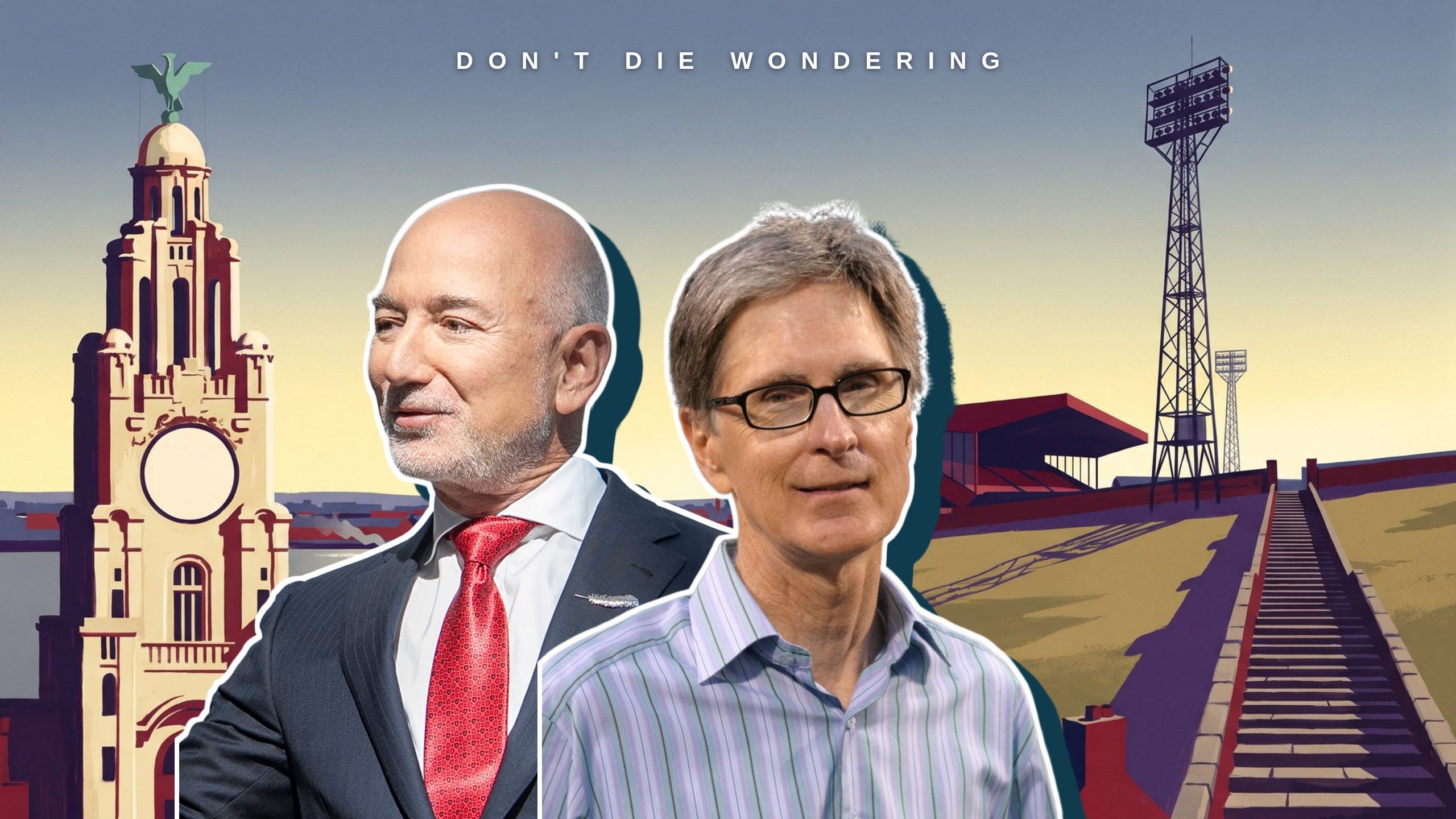
Cover: photographs Webjedi (John W. Henry, CC BY-SA 4.0) and Alexander Kubitza, US Navy (Jeff Bezos, public domain) via Wikimedia Commons, cut-outs; illustration, DDW.