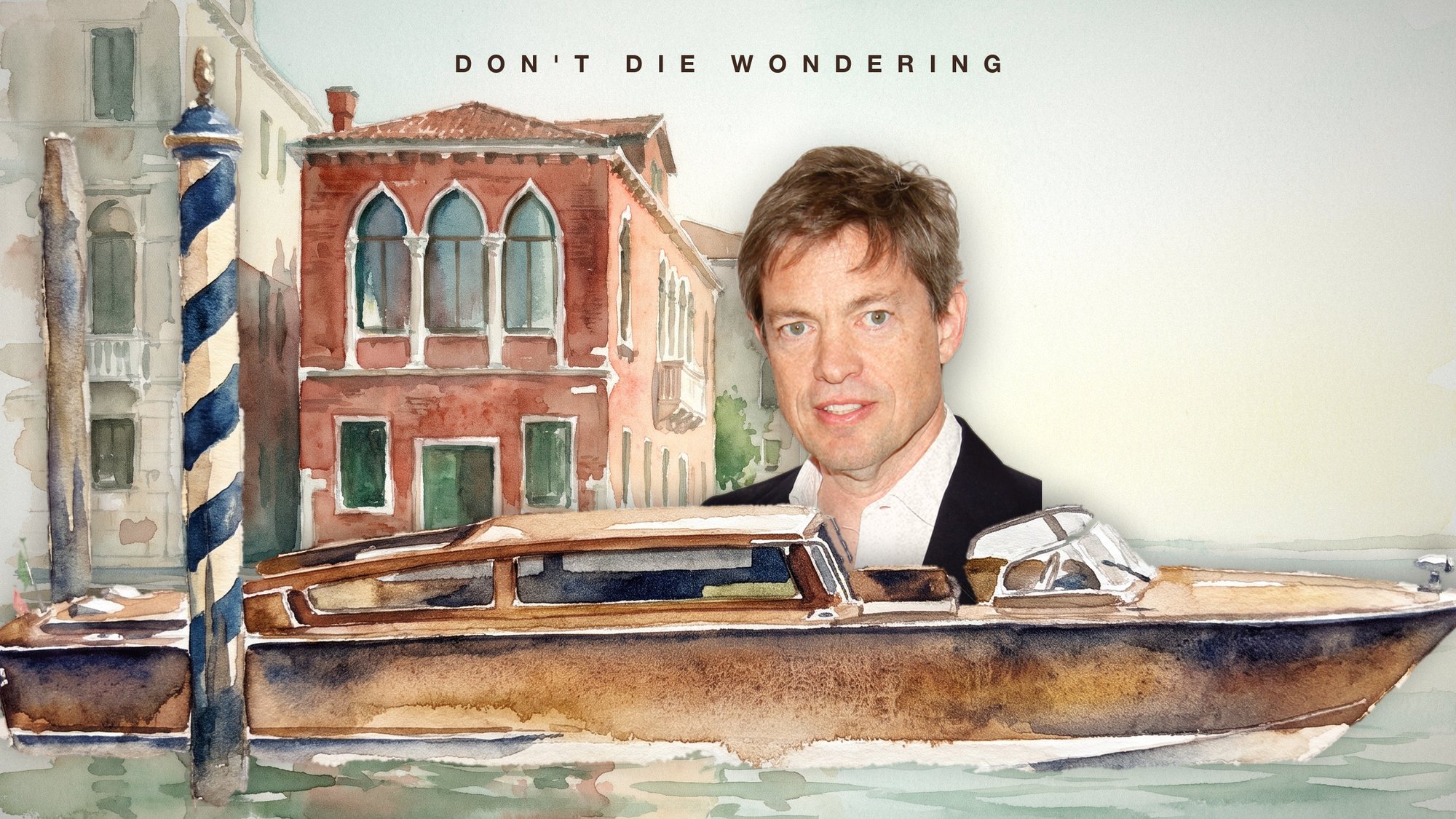
The nickname says homeless billionaire, yet his surname now hangs over a neo-Gothic house on the Giudecca, an eighteenth-century Venetian palazzo and several hundred acres above Los Angeles, which is a great deal of roof for a man supposedly without one.
Two words follow Nicolas Berggruen about, and the one that sticks is the one that fits least. The homeless billionaire, a label Forbes was running as a headline by 2011, is now the founder of a think tank with its European headquarters in a neo-Gothic house on the Giudecca. He set up an arts foundation whose public face is a Venetian palazzo built for one of the city’s grandest families. He also bought a mountainside in Los Angeles on which Herzog & de Meuron have designed a campus with a monastery’s habits. Behind all of it is a property company that has been buying offices and flats since the 1980s.
Our reading is that the nickname never described a man without property. It described a man who kept his property at one remove, in a company’s books rather than a front door with his name on it. What has changed since is the direction of the money. The fortune that went into apartment blocks now also goes into buildings for other people to think in, and the ones in Venice sit with bodies that carry his surname.
Three of those bodies need keeping apart before any number makes sense. Berggruen Holdings is his private company. The Berggruen Institute, founded in 2010, is a private foundation. Berggruen Arts & Culture is a separate charitable foundation he set up. A building on the books of one is not on the books of another, and none of them is quite the same thing as the man.
The figure from outside
Forbes’s estimate puts his fortune at $2.9bn as of 8 November 2026. Like any figure for a private fortune, it is a valuation made from outside.
The same profile gives his age as 65, his marital status as single and his residence as Beverly Hills. Few men have been so thoroughly housed by a single line of a database. The nickname, whatever it once captured, now describes a man with a Beverly Hills postcode, and it has outlived its usefulness as anything but a search term.
Buildings first
From buildings, mostly. Berggruen Holdings dates to 1985, after an early spell in real estate with Bass Brothers Enterprises, the Texan investment house. The company owns office buildings and apartments in Berlin and in Portland, Oregon. In March 2022 The Real Deal, reading the company’s own website, counted 100 properties in Berlin and four in Paris, and holdings across Portland, Los Angeles and Seattle that the company put at $1bn.
There is an artistic inheritance in the family, though not one that pays dividends. His father, Heinz Berggruen, was the collector whose pictures became the Museum Berggruen. The father’s name ended up on a museum. The son’s is on a property company, a think tank and, lately, a pair of Venetian addresses. It is a familiar enough arc in old families: one generation acquires beautiful things, the next acquires the buildings to put things in.
What the Institute is for
The Institute’s stated purpose is to develop foundational ideas and, through them, to shape the political, economic and social institutions of the twenty-first century. It is an ambition that would look grand on a dinner invitation and positively heroic on a planning application.
Formally it is a Los Angeles private foundation, tax-exempt since July 2014, filing the American form reserved for private foundations. In practice it convenes people, and it describes its Venetian headquarters as a house of ideas, built for summits, workshops, symposia and exhibitions.
That vocabulary matters, because it explains the buildings. A think tank can live in rented rooms and a conference hotel, as most do. The Berggruen Institute has chosen to own the rooms, and to choose them with some care for the view. Ideas, it turns out, travel better from a terrace.
Two houses on the water
The first purchase was Casa dei Tre Oci, a neo-Gothic house on the Giudecca designed by the artist Mario De Maria and built in 1913. In March 2021 the Institute signed a preliminary agreement to acquire it from the Fondazione di Venezia, and in announcing the deal said it would “preserve the Tre Oci’s function and identity as part of the cultural fabric of Venice.” The seller kept a foot in the door: the Fondazione would carry on using the house for its photography programme for two years after the final agreement. It could also join the Institute on future exhibitions.
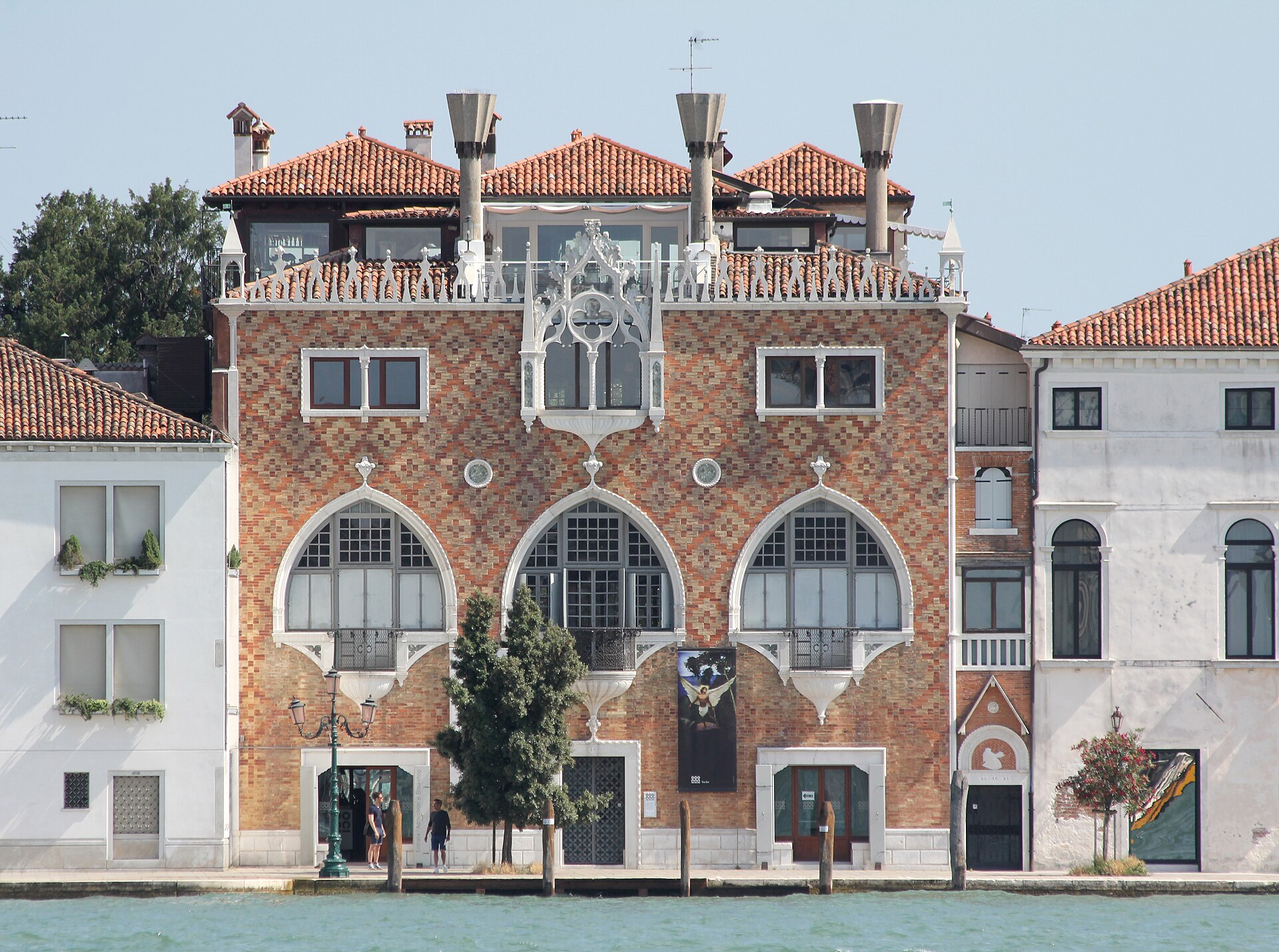
It is a gracious way to buy a landmark. The Venetians keep their exhibitions for a while, the newcomer acquires a reputation for good manners along with the freehold, and nobody has to write an angry letter to Il Gazzettino.
By June 2022 the Italian text of an Institute release said it had recently bought two properties in Venice that would become the centres of its European activities, and Berggruen himself supplied the rationale, saying that “Venice has been the gateway linking the West to the East for over 700 years.” That announcement names only one of the two, the Tre Oci.
So the count since 2019, on the Institute’s own word, is two buildings, both in Venice, one of them named. After eight months of restoration, the Tre Oci opened to the public as the headquarters of the Berggruen Institute Europe on 23 March 2024.
Palazzo Diedo, and whose name is on it
Palazzo Diedo is the public face of Berggruen Arts & Culture, the separate charitable foundation he set up, and the foundation describes the palazzo’s purpose as linking contemporary art with the past, and East with West. Whose name sits on the deed is another matter, and the Institute’s 2022 announcement, with its two purchases and one name, leaves it there.
The building has had a varied career. It is an eighteenth-century palazzo by Andrea Tirali, once home to one of the most powerful families in Venice and later a primary school and a court. That is a CV with range: patricians, then pupils, then plaintiffs, and now visitors with a catalogue under one arm.
It reopened in April 2024 with JANUS, an exhibition of eleven permanent interventions by eleven artists, which means the palazzo’s walls now carry work that does not go back in the crates when the show ends. The foundation’s architect, Silvio Fassi, lists Ca’ Diedo among his projects for it, alongside the Giudecca house and a site at Porto Marghera, Venice’s industrial mainland.
Between the Tre Oci and the Diedo, the Berggruen name now occupies two of the more photographed façades on two different stretches of Venetian water. For a family whose earlier fame rested on a collection given to a museum, it is a neat reversal: this time the family has the museum, or something very like one, and the art comes to it.
The hillside above Los Angeles
Something larger, slower and considerably more argued over. Berggruen told Architectural Record he had paid $45m for the land in 2015, and that the campus would cost “hundreds of millions of dollars”, all of it his own.
In May 2016 the Institute announced it would build in the eastern Santa Monica Mountains, near Topanga State Park, and submitted a site plan by Herzog & de Meuron to the City of Los Angeles, which set the environmental review in motion. The firm of Jacques Herzog and Pierre de Meuron describes a scheme in which, “in line with monastery tradition”, most fellows would study, meet, eat and sleep inside the Institute’s building. The same report put the proposal at quarters for up to 50 visiting scholars and a “chairman’s house” of 26,000 sq ft, which is roughly what a monastery would build if the abbot had a property company.
The site is about 450 acres, and the Institute has proposed building on fewer than 22 of them, leaving roughly 95 per cent as it is. A decade after the land was bought, the architects’ own page still speaks of a campus that will be built.
The design sits on Herzog & de Meuron’s website in the meantime, elegant, low and long, a monastery for the age of the long-haul flight.
Whose money the buildings are
Not in the way the $2.9bn is, and the Institute’s own returns show how little of the property sits with the think tank. Its American filings, read on ProPublica’s Nonprofit Explorer, put total assets at $5.9m at the end of 2024, down from $10.5m a year earlier, on revenue that has run between $10.8m and $23.7m over the last three filed years. A hillside bought for $45m cannot be sitting on a balance sheet that size. Berggruen, as chairman, draws nothing from it; the best-paid officer, a vice-president, drew a little over $400,000 in 2024. So the Venetian houses and the Los Angeles land are where his fortune has been turned into something with a public front door, held, by our reading, at the same one remove the nickname always described. A fourth vehicle, the Nicolas Berggruen Charitable Foundation, has filed its own returns from 2010 to 2024, and lists him as its director and president, with his compensation for the job shown as $0.
Read Next: The Getty Family Net Worth in 2026, and Who Inherits
Cover: photograph Financial Times via Wikimedia Commons (CC BY 2.0), cut-out; illustration, DDW.