



The Shape Beside the Stone: Tapered or Straight Solitaire Shoulders?
A yellow-gold solitaire can look almost weightless beside the diamond, or feel like a gold ring with a diamond as part of its design. You do not always need a different stone to move between those impressions. Sometimes the change is in the shoulders.
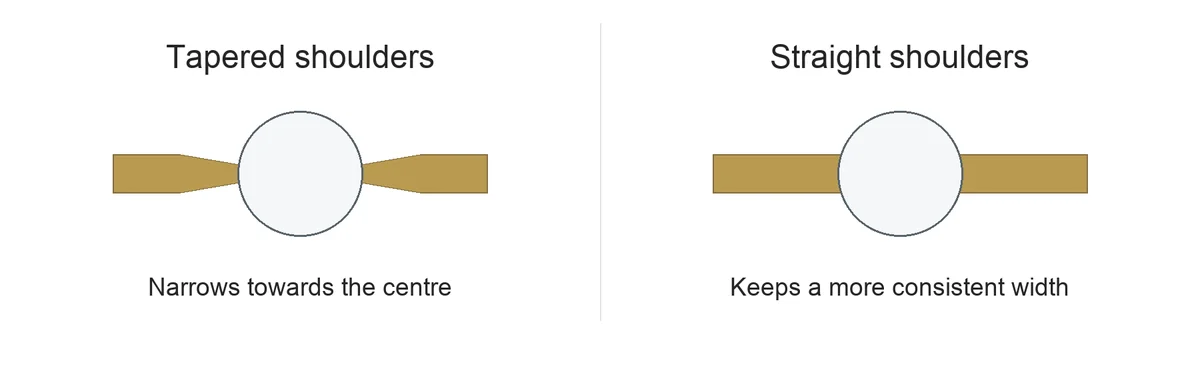
These are the sections of the band on either side of the centre setting. When they narrow towards the diamond, the eye follows a taper. When they keep a more consistent width, the gold makes a steadier line across the finger. Neither needs extra stones to give a familiar solitaire its own character.
Find where the band changes width
Here, tapered means the shoulders become narrower as they approach the diamond. Some jewellers call this a reverse taper; others use tapered for a band that narrows in the opposite direction. Straighter shoulders remain more nearly parallel. Following the direction of the narrowing is more useful than relying on the label alone.
Among Lily Arkwright’s solitaire rings in yellow gold, Serenity pairs a round lab-grown diamond with a tapered six-claw mount in 18ct gold. Its shoulders narrow towards the centre, creating a shaped transition from gold to diamond.
A gradual taper or a pinch beside the stone
The length of the narrowing changes its character. A gradual taper carries the gold towards the diamond in a long sweep. The change may be barely noticeable at first, then become clearer where the band reaches the setting. It can give the metal a drawn-out, flowing shape even when the rest of the ring is quite spare.
A short pinch close to the diamond feels more concentrated. Most of the visible band keeps its fullness, then narrows over a small distance beside the centre. That makes the junction more pronounced: the fuller gold and the round stone remain distinct shapes, connected by a finer section. Straighter shoulders make a steadier connection, with less change in width as the band reaches the setting.
Close-ups at the same scale, ideally with similarly sized centre stones, help reveal the difference. Follow the shoulder from its fuller section towards the diamond, keeping the transition visible. The complete ring then shows whether you enjoy a long sweep, a brief pinch or a more even line of gold.
Separate taper from thinness
A tapered band is not necessarily the narrower ring overall. A band measuring 2.5mm away from the setting could narrow to 1.6mm beside it; another could remain 2mm wide as it approaches the centre. These illustrative widths are not recommended structural dimensions. They show why one advertised band-width measurement cannot describe the whole shape.
A quoted width needs a location, and it does not tell you the depth of the metal. The dimensions at the shoulder and beneath the finger answer different questions. A jeweller should confirm whether the proposed proportions suit the particular setting.
The same distinction applies to height. A shoulder can narrow in the view from above while rising towards the setting in profile. GIA’s guide to ring settings describes cathedral shoulders as arches supporting the centre. That upward curve and the taper in width are separate features, even when they appear in the same ring.
Let the gold work with your other jewellery
A broad gold watch bracelet beside straighter shoulders creates a repetition of substantial metal. A taper introduces a change of scale, drawing that same warmth into a finer section beside the diamond. With smaller jewellery, a more even band can add a clear gold line, while a taper keeps the detail concentrated near the stone. These are different combinations to explore, rather than clues that dictate your preference.
The idea behind coordinated ring sets is useful here: shared yellow gold can connect a tapered solitaire and a straight band while each keeps its own outline. Matching a metal colour does not require matching the shoulder shape.
Seeing both rings beside your usual watch or bracelet makes those differences more tangible than an isolated close-up.
Where the gold meets the setting
The junction can be a crisp change of direction or a softer curve. Either may be intentional. The useful question is whether that transition belongs to the design, rather than whether every shoulder follows the same ideal line.
The appearance of a fine shoulder does not establish its strength. Ask the jeweller about the width and depth of that section and how it supports the chosen setting. A top-view photograph shows the outline, while the construction also needs assessment from other angles.
“Narrows just before the diamond” and “keeps a clear gold line across the finger” describe two quite different attractions. Either tells a jeweller more than “simple gold solitaire”, because the preference is in the gold as much as the stone.