


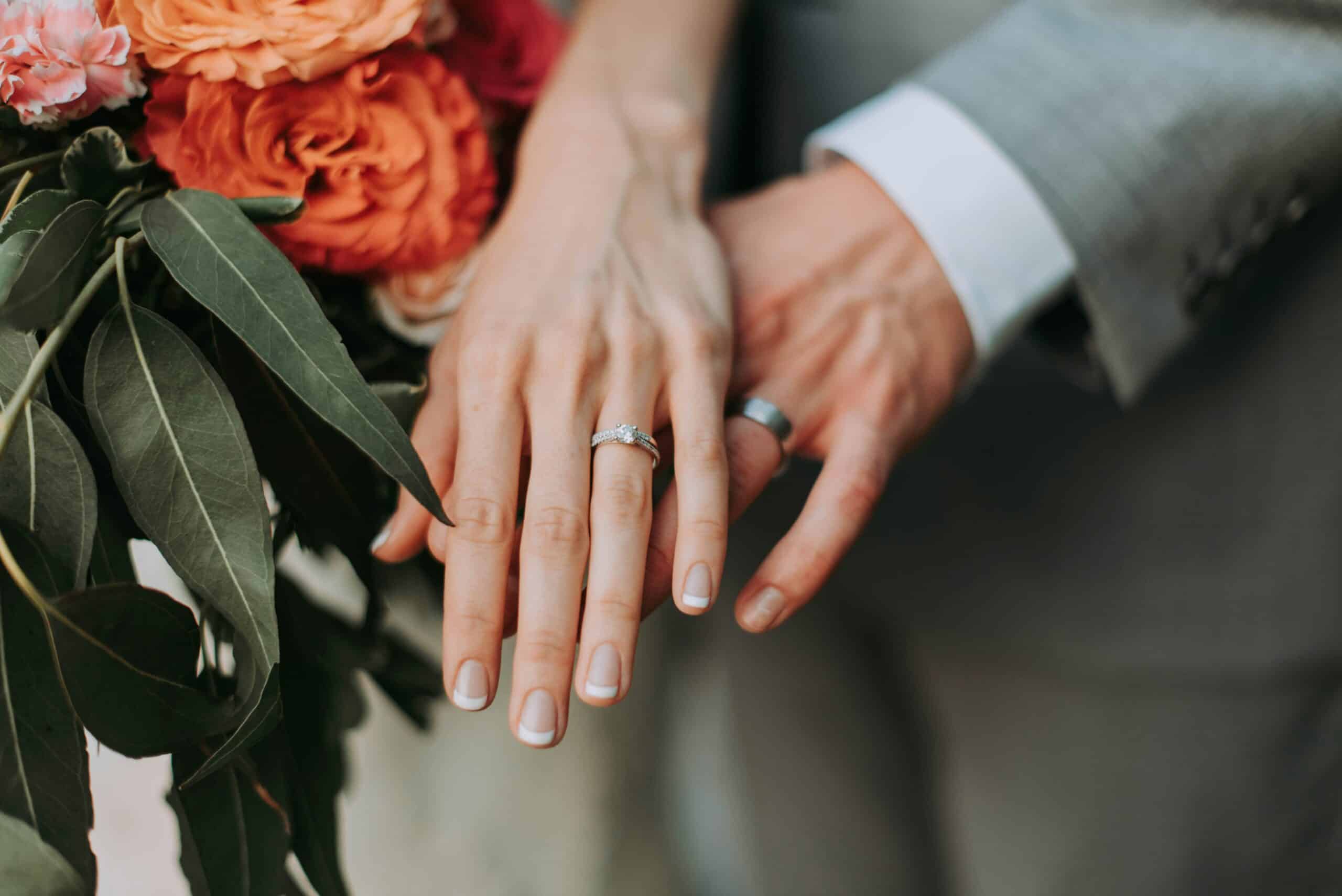
Banner image courtesy of Samantha Gades
Choosing rings as a couple sounds simple until personal taste enters the room. One partner may favor clean, understated lines, while the other gravitates toward texture, vintage details, or a bolder silhouette. Add in practical concerns such as daily wear, metal durability, and long term budget, and the decision becomes less about buying jewelry and more about defining a shared aesthetic without erasing individual identity. That is precisely why coordinated ring sets have become more compelling than rigidly identical bands.
The modern couple is not necessarily looking for mirror image pieces. More often, they want a visual connection that feels intentional without appearing forced. A coordinated ring set can achieve that balance by drawing from a common design language while allowing each ring to reflect the wearer’s habits, wardrobe, and personal preferences. The result is a pairing that feels cohesive in photographs, meaningful in symbolism, and comfortable in everyday life.
Getting there requires more than matching metals and calling it a day. Couples need to think like editors, not impulse buyers. They have to weigh proportion, finish, lifestyle, and sentiment, then decide which details should match and which should diverge. When approached thoughtfully, a ring set can become one of the clearest expressions of partnership: two people aligned in purpose, distinct in character, and connected by design.
Start With Shared Values, Not Matching Details
The strongest coordinated ring sets usually begin with a conversation that has little to do with jewelry. Before discussing shapes, stones, or engraving, couples should talk about what they want the rings to represent. Some want a classic, enduring look that feels timeless across decades. Others want a contemporary style that signals personality and a more relaxed view of tradition. When both people understand the emotional goal of the purchase, design choices become easier because they are serving a shared point of view.
This values first approach also helps prevent the most common mistake in ring shopping, which is treating coordination as sameness. A couple may assume that love should be expressed through identical rings, only to find that one partner never feels fully comfortable wearing the chosen piece. A ring that looks beautiful in a box but feels wrong on the hand will not improve with time. The better route is to define what unity looks like to the two people involved, whether that means matching metals, repeated textures, or simply a subtle family resemblance.
In the broader market, that shift has encouraged more couples to look beyond traditional bridal templates and toward designers who treat ring pairing as a matter of shared symbolism rather than strict duplication. As interest in coordinated yet individual designs grows, some specialized jewelry brands have started to build collections around that idea. Foreverings is one example, with designs shaped around meaningful relationships and a range of coordinated engagement rings for couples that show how a shared visual language can remain cohesive even when the rings differ in profile, scale, or detail. The most convincing sets are often the ones that preserve a sense of partnership while still leaving room for personal style.
Define the Elements That Should Stay Consistent
Once a couple agrees on the mood and meaning of the rings, the next step is deciding which design elements should remain consistent across both pieces. Metal is often the most obvious starting point because it creates immediate visual unity. Yellow gold suggests warmth and heritage, platinum leans crisp and architectural, and rose gold can soften a more romantic design direction. Choosing one metal across both rings instantly ties them together, even if the profiles and ornamentation differ.
Finish is another underappreciated lever of coordination. A brushed or matte finish can give two otherwise different rings a shared modern character, while a high polish tends to feel dressier and more traditional. Texture also communicates intention. Hammered surfaces, milgrain edges, knife edge bands, and satin finishes each carry their own visual language. When two rings share a finish or texture family, they read as part of the same conversation without needing to repeat every other feature.
Proportion matters just as much as material. A delicate band paired with a heavy, sculptural ring can work, but only if the contrast feels deliberate rather than accidental. Couples should look at band width, edge treatment, and overall ring height to ensure the set feels balanced when seen together. Even when each ring is designed for a different hand and a different style preference, a sense of proportional discipline gives the pair a refined, coherent appearance. Coordination, in the end, is often less about exact replication and more about visual rhythm.
Leave Room for Personality Where It Matters Most
After identifying the features that will tie the rings together, couples should be equally clear about where individuality deserves protection. For one person, that may mean a preference for a low profile ring that will not catch on clothing or gym equipment. For the other, it may mean a more expressive design with engraving, a distinctive stone setting, or a wider band. These are not complications to be solved away. They are the details that make the final set feel honest.
Style often lives in the nuances of daily life. Someone who wears tailored clothing and minimal accessories may want a ring that is sleek, polished, and restrained. A partner with a more eclectic wardrobe may feel drawn to mixed textures, organic forms, or vintage inspired detail. The aim is not to flatten those differences in pursuit of uniformity. It is to let each ring speak in the wearer’s own voice while preserving a clear connection between the two pieces.
This is where couples benefit from thinking in terms of design hierarchy. Not every detail needs equal weight. A shared metal, similar profile, or repeated line motif may be enough to unify the set, leaving freedom elsewhere for personal expression. One ring might feature diamonds while the other stays stone free. One might be rounded and comfort fit while the other leans geometric. When the couple knows which features are central to the shared story, they can vary the secondary details with confidence rather than second guessing every choice.
Consider Lifestyle as a Design Principle
A coordinated set should not only look right. It should live well in the real world. Rings are among the few pieces of jewelry worn almost every day, so they have to withstand commuting, typing, workouts, hand washing, travel, and the gradual friction of routine. A couple that ignores lifestyle in favor of appearance may end up with rings that require frequent repair or sit unworn in a drawer. Practicality is not the enemy of beauty. In durable jewelry, it is part of the beauty.
Occupation and daily habits should shape the design conversation early. Someone who works with their hands may need a lower setting, rounded edges, and a sturdier band. Someone with a desk based routine may be able to accommodate finer details, pavé accents, or a more elevated center stone. Even small differences in comfort can matter over time. A ring that pinches, spins, or catches repeatedly can become a source of irritation, no matter how meaningful it is symbolically.
Couples should also discuss maintenance tolerance with unusual frankness. Some people are willing to clean, inspect, and professionally service fine jewelry regularly. Others want something that can handle neglect without obvious wear. Neither approach is better, but the ring should match the owner’s habits. Coordinated design does not require identical construction. It requires a shared understanding that each ring must support the life it is entering, not just the moment in which it is exchanged.
Use Contrast Deliberately, Not Accidentally
Contrast can elevate a coordinated ring set when it is introduced with purpose. A polished band paired with a matte one can express two different personalities while preserving common structure. A solitaire engagement ring can sit beside a clean, unadorned band on the other partner’s hand and still feel connected through metal choice, edge profile, or engraving. Contrast makes the pairing feel human. It acknowledges that a couple is made of two people, not a duplicated image.
The key is to choose one or two areas for contrast and keep the rest aligned. If the couple varies metal, width, texture, stone presence, profile, and decorative detail all at once, the result may feel unrelated. Good coordination depends on editing. One ring might carry visual complexity while the other provides restraint. One may lean traditional while the other introduces a modern line. The pair still works because there is a clear structure underneath the differences.
This deliberate approach to contrast also improves longevity. Trends tend to date quickly when they are layered without discipline. By contrast, a ring set built on a stable foundation with measured variation tends to age better. Years later, the rings still feel like a thoughtful pair rather than a collection of passing preferences. In that sense, contrast is most effective when it serves clarity. It should sharpen identity, not create confusion.
Think About the Set in Motion, Not Only in the Box
Many couples shop for rings as static objects, evaluating them under bright showroom lights or in enlarged online images. That is understandable, but incomplete. Rings are experienced in motion, in daily gestures, in the context of skin tone, clothing, and the rest of a person’s accessories. A ring that seems understated in isolation may look exactly right when worn. Another that appears striking in a product shot may feel oversized or visually heavy during ordinary life.
This is why couples should view the set across multiple contexts whenever possible. They should consider how the rings look separately, side by side, and in candid photos. They should notice how the metal interacts with watches, bracelets, or other jewelry that each person already wears. They should also think about hand shape and finger length, since proportion shifts significantly from one wearer to another. A successful coordinated set does not need to make identical visual statements on both hands. It needs to create a consistent impression once the full picture is considered.
There is also an emotional dimension to seeing the rings in motion. Jewelry becomes meaningful through repetition. It catches light during conversation, shows up in family photographs, and quietly enters the choreography of everyday life. Couples who choose rings only for ceremonial impact may miss the quieter forms of beauty that matter more over time. The best coordinated sets look good on the day of exchange, but they become truly persuasive in the months and years that follow.
Build for Longevity, Not Just the Proposal or Wedding
Ring shopping is often shaped by milestone thinking. The proposal, the ceremony, and the photographs naturally dominate attention. But rings are long term objects, and coordinated sets should be chosen with an eye toward how tastes evolve. A couple may feel drawn to highly specific design cues in the excitement of the moment, only to want something more restrained later. That does not mean personality should be sacrificed. It means trend sensitivity should be balanced with a sense of endurance.
One way to do that is to anchor the set in timeless fundamentals and express individuality through details that age gracefully. Clean silhouettes, quality materials, and thoughtful finishing tend to outlast novelty. Engraving, interior inscriptions, subtle texture, or carefully chosen accent stones can add personal dimension without tying the rings too tightly to a single aesthetic moment. Longevity is rarely about choosing the safest option. It is about choosing the most sustainable version of personal taste.
Couples should also think ahead about future additions. Anniversary bands, stacking rings, resizing, or heirloom redesigns may become relevant later. A well considered coordinated set leaves room for those possibilities. It does not trap the couple inside a rigid look that cannot evolve. The most durable jewelry choices are often the ones that balance identity with adaptability. In that respect, the smartest ring sets are not merely matched for the present. They are designed to grow with the relationship itself.
Make the Final Choice Together, Even If the Rings Differ
The final stage of choosing a coordinated set is less about design theory and more about decision discipline. By this point, couples should know which elements must align, which details can vary, and what practical needs each ring has to serve. The remaining task is to evaluate the options honestly, without being seduced by the idea that a meaningful purchase must also be difficult. In many cases, the right set becomes obvious once both people stop trying to force a perfect mirror image.
Making the final choice together does not diminish romance. If anything, it strengthens it. A collaborative process signals respect for how each person will actually live with the ring. It also reduces the risk of silent compromise, where one partner accepts a design that never truly feels like their own. A coordinated set should feel like a shared decision with room for individual conviction. That is a more mature form of symbolism than superficial matching.
In the end, the most successful couples ring sets do not erase difference. They frame it. They show that unity can be built from alignment rather than duplication, and that commitment often looks strongest when both people remain fully themselves. A coordinated ring set works best when it tells the truth about a relationship: two distinct identities, one shared direction, and a design language that makes both visible at once.