


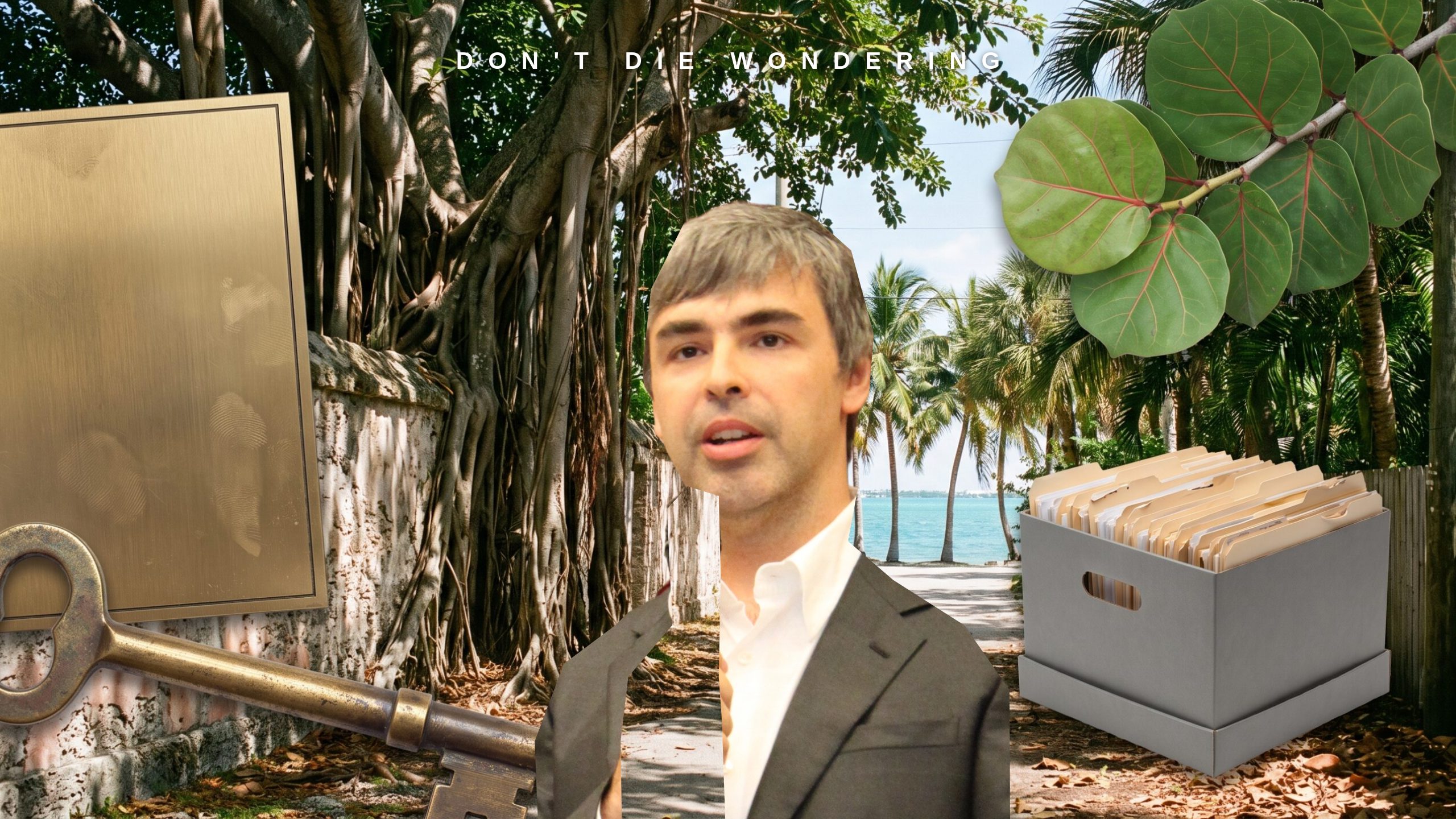
Larry Page has spent close to $190 million on houses in one Miami neighbourhood, according to Bloomberg and The Real Deal, and appears to have spent nothing at all on a nameplate. On 27 August, both outlets reported that Koop, his private family office, had signed a lease in Coconut Grove. Bloomberg, citing two anonymous sources, described a boutique seven-storey building near Barnacle State Park and noted that Koop’s name is not listed on the property’s directory. The square footage and the address were not specified. A broker who leases two office buildings in the neighbourhood told The Real Deal he had never heard of Koop.
That is the whole story, and it is more informative than most disclosures.
The Tenant
Koop has no website. Bloomberg’s reporting is blunt about the rest: Page’s staff do not advertise where they work, and details of his investments rarely leak. For a man whose net worth Bloomberg put at $272 billion in January, making him the second-richest person alive at the time, this is an unusual level of administrative invisibility. Most fortunes of that size arrive somewhere with lawyers, a logo and a leasing press release.
The landlord, Bloomberg reported, is Azora Private Solutions, which declined to comment. Azora is led by Juan José Zaragoza, Arturo Vinueza Eastman and Ignacio Gil-Casares, and its office holdings in the neighbourhood include a seven-storey, 57,000-square-foot building at 3225 Aviation Avenue, bought for $34 million last autumn, and a seven-storey, 55,000-square-foot building at 3480 Main Highway, bought for $61 million this year, according to The Real Deal. Neither outlet said which building Koop took, and nobody has confirmed the tenancy on the record.
What the lease is for remains unreported. Term, rent, expansion options: none of it has surfaced. Whether the Miami office houses an investment team or a legal and administrative base is also unconfirmed. The absence is the texture. A family office that runs $200 billion-plus of exposure to a single share price does not need a lobby presence; it needs a room, a door and a printer.
The Assemblage
The property came first, in a run of purchases that read like a man buying a coastline in instalments.
In December 2025, sources told The Real Deal that Page was the buyer of Banyan Ridge, a 4.5-acre waterfront compound at 3585 Anchorage Way on Biscayne Bay, which traded for $101.5 million according to the Multiple Listing Service. The seller was the estate of Jonathan Lewis, a prominent Miami restaurateur and LGBT advocate, now deceased. Around the same period, three LLCs tied to Page were incorporated in Florida, records show.
Then, in January, the neighbour: a 10,400-square-foot, seven-bedroom, eight-bathroom house at 3085 Munroe Drive for $71.9 million, sold by Shaklee Corp chief executive Roger Barnett and his wife, the journalist Sloan Barnett. Later that month, an add-on at 3320 Devon Road for nearly $15 million, a property that abuts one of the others. The Real Deal put the running total at roughly $188 million.
Assemblage is the polite term for buying your neighbours before they become a view problem.
Sergey Brin, Page’s co-founder and, per Bloomberg’s January ranking cited by The Real Deal, the fourth-richest person in the world at $253 billion, was shopping in the same waters. Sources told The Real Deal that Brin made an offer of about $50 million for a waterfront house in Miami Beach. Fortune, in July, put the two founders’ combined Miami property spending at around $225 million.
Meanwhile Alphabet itself has been leasing. The Real Deal reported that the company more than quadrupled its Brickell footprint this spring and now takes about 45,000 square feet at 1450 Brickell Avenue, up from 10,000. Corporate Miami and personal Miami arrived within months of each other, which in a company of Alphabet’s size is not necessarily the same decision twice.
The Ballot
The context nobody involved will discuss on the record is Proposition 40, the California billionaire tax, which goes to voters on 3 November 2026. It is a combined initiated constitutional amendment and state statute; if approved, the state’s billionaires would pay a one-time 5 per cent levy on accumulated wealth. PwC’s summary of the initiative describes a phase-out between $1 billion and $1.1 billion in net worth. On 26 April, SEIU-UHWW announced it had gathered 1.6 million signatures, nearly double the 874,641 required to qualify.
It is not law. It faces stated constitutional challenges and organised business-community opposition, and until November it is a proposal with a very large signature count attached.
The Legislative Analyst’s Office ballot analysis notes one detail that any adviser would have flagged in about four seconds: real estate, pensions and retirement accounts would be excluded from the tax base. A $101.5 million compound on Biscayne Bay is, in that framing, a different category of asset from 390 million shares of Alphabet Class C stock.
Public filings from the California Secretary of State’s office, reviewed by Fox News Digital, show several business entities linked to Page were moved out of the state in December, ahead of the 1 January 2026 residency date tied to the proposed tax. Those filings indicate that Koop LLC and Flu Lab LLC, his influenza research fund, no longer operate in California, and that One Aero, his flying-car venture, now lists a primary address in Florida.
None of this is illegal, and none of it has been explained. Page has not commented publicly. Whether he has personally shifted his tax residency, as opposed to relocating entities, has not been established by any of the reporting; sources cited by the outlets covering the move say it is unclear whether it proves permanent. New York Times, Wall Street Journal, Business Insider and Fox Business coverage has framed the ballot measure as a motivating factor in the wider billionaire migration. That framing belongs to those outlets, not to Page, who has said nothing at all.
The Money
Pinning a number on him is a moving exercise. The Real Deal, citing Bloomberg, had Page at $272 billion in January 2026. Fortune, in July, put him at $297 billion and Brin at $276 billion. Across 2026, published estimates have ranged from roughly $261 billion to $325 billion, because Alphabet’s share price moves daily and methodologies for private assets differ.
The underlying position is more stable than the headline figure. Bloomberg’s billionaires profile notes that Page holds Class B and C shares giving him about 6 per cent of Alphabet according to its 2026 proxy, including about 390 million Class C shares. Celebrity Net Worth’s profile puts the combined Page and Brin voting control at 51 per cent of the company through super-voting stock. Two men, one company, a majority of the votes, and one of them has just taken an office nobody can find.
Page is 53, born in East Lansing, Michigan, and co-founded Google with Brin in 1998. He stepped down as Alphabet chief executive in 2019 and has been conspicuously absent from public comment since. He has been married to Lucinda Southworth since 2007; they married on Necker Island and have two children.
The Grove
Coconut Grove has been collecting this kind of money for a while, and the appeal is legible: banyans, water, a small-village street grid, and a distance from Brickell’s glass that can be measured in minutes but reads as several social categories. Azora’s two purchases, at $34 million and $61 million within about a year, suggest the office market there has been repriced by someone’s arrival, though not necessarily by Page’s.
What Miami gains here is not a name on a building. It is a permanent address for one of the largest private capital pools on earth, staffed by people who will not tell you where they work, run out of a building whose landlord declines to comment, under a company name that a broker leasing the block had never heard.
The directory stays blank. That is the point.
Cover photograph: Stansfield PL via Wikimedia Commons (CC BY-SA 3.0).