


Frank Woolworth’s horses were stabled there in 1899; Carl Fischer worked there for decades, shooting Esquire covers of Muhammad Ali, Andy Warhol and Richard Nixon. In October it sold for $10.75 million to a trust.
I keep thinking about the horses.
Frank Woolworth, who built an empire on things that cost five and ten cents, kept his animals on East 83rd Street in a private stable twenty-five feet wide, designed by Hamilton & Mesereau in 1899. Twenty-five feet is a narrow frontage for a fortune of that size, which was always the discipline of a private stable, where the money stayed indoors. The building outlasted the horses, the dime stores and the man.
It is useful to remember what a building like this was for. A private stable was infrastructure, closer in spirit to a garage than to a drawing room, and it existed so that something else a few streets away could run smoothly. Nobody was meant to admire it. The architecture was good because the address demanded good architecture, not because anyone expected guests. That is why so many of them survive: a structure designed to be useful and unremarkable is a structure nobody tears down in a hurry.
This month it sold for $10.75 million. The buyer has a name on the deed, and the name does not belong to a person.
The deed, dated 2 October and recorded with the city on the 13th, lists the Article IV Trust for Bruce Marshall Langone, set up under a 2025 irrevocable grantor retained annuity trust, according to the New York Post’s reading of the filing. Ken Langone, his wife Elaine and their son Bruce are all named as trustees, which makes the purchaser a committee of three people sharing one surname. Eleven days passed between the signing and the recording, which is roughly the length of time it takes for a private transaction to become a public document and then a headline. The Home Depot fortune has bought Woolworth’s stable, and bought it in a son’s name.
There is a tidiness to that which is hard to ignore. One American retail fortune, built on volume and small margins, has acquired the service building of another American retail fortune, built on volume and smaller margins still. Nothing about the arrangement is sentimental. It is simply a narrow, well-made house in Carnegie Hill that has spent its entire existence being owned by people who made their money selling very large numbers of inexpensive things to very large numbers of people.
Twenty-Five Feet of Carnegie Hill
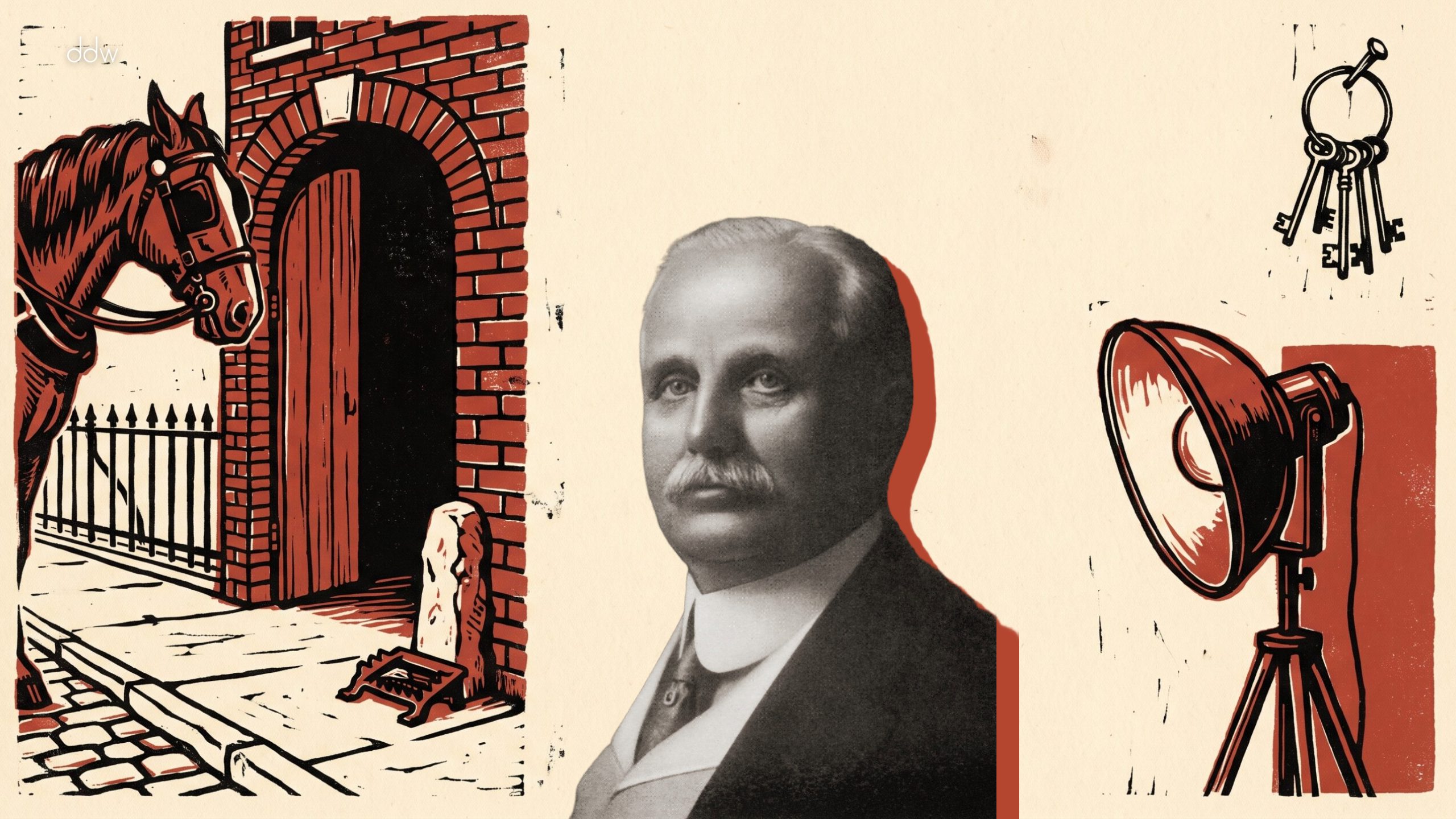
Between the horses and the trust, there was Carl Fischer.
Fischer used the carriage house as home and studio for decades, and his family lived in the apartment above the studio, as his obituary recounts. Downstairs he made some of the most recognisable magazine covers of the twentieth century: Esquire images of Muhammad Ali, Andy Warhol and Richard Nixon among them. The Post dates the Ali session to 1967 in Manhattan, for the April 1968 cover, which puts one of the most argued-over covers of the decade inside a room originally measured for carriages. His work sits in the permanent collections of the Metropolitan Museum of Art and the Museum of Modern Art. He died at home in New York on 7 April 2023.
Consider the commute. A photographer with pictures in the Met and MoMA went downstairs to work and upstairs to dinner, in a building with a frontage the width of a generous hallway. The arrangement explains something about the longevity of these houses. A stable has high ceilings, wide doors and a ground floor built to take weight and mess, which is a description of a stable and also a description of a photographic studio. The horses left behind exactly the floorplan the next tenant needed.
So the building has a specific and unusual CV. Stable, then studio, then the quiet interval that follows a death in a house that was also a workplace. Three and a half years separate Fischer’s death from the October deed. Houses with one long-term owner tend to take their time.
What it is today is less romantic and, admittedly, the detail I enjoy most. The property runs to 7,800 square feet, with doctors’ offices on the ground floor and in the basement and a residential duplex above, per The Real Deal, which also reported that Leslie J. Garfield had the listing, with Jed Garfield, Caylyn Sullivan, Lydia Rosengarten and Kalli Meagher on it. Seven thousand eight hundred square feet behind twenty-five feet of frontage is a building that goes backwards and upwards rather than sideways, and the floorplan now reads like three separate centuries sharing a staircase. Woolworth’s grooms, Fischer’s lights, a waiting room.
Run the arithmetic and $10.75 million across 7,800 square feet comes to roughly $1,378 a foot, which for a detached house in Carnegie Hill is the sort of number that makes brokers reach for the word “opportunity” and buyers reach for a structural engineer. Medical tenancy is the reason. Ground-floor and basement consulting rooms are a reliable, unglamorous income and a complication for anyone who wants the whole house, and the price reflects the complication rather than the address. Five names on the listing sheet for one twenty-five-foot building also tells you something about how these sales are handled: quietly, thoroughly, and by people who know every carriage house on the Upper East Side by its lot number.
Article IV
The structure is where this stops being a property story.
A grantor retained annuity trust is a legal, well-worn instrument, and the Post describes it plainly: GRATs are “a favorite estate planning tool of the ultra-wealthy, letting families shift assets to the next generation while keeping the gift tax bill to a minimum,” as the paper put it in its report on the deed. Nothing exotic, nothing contested, and nothing that anyone involved would consider worth discussing at lunch. Families with assets of this size use them the way everyone else uses a mortgage, which is to say constantly and without commentary.
The naming is the part that lingers. “Article IV Trust for Bruce Marshall Langone” is not a brand or a shell with a view of the park behind it. It is a signpost to a clause in a longer document, the fourth article of something that evidently has at least four, and it tells you that a house in Carnegie Hill has been slotted into a paragraph drafted for a family with three sons. The middle name is there because lawyers are precise. The trust is dated 2025, and it was spending by October.
Three trustees, one surname, one deed. Elaine Langone’s name on the filing alongside her husband’s and her son’s is the detail that makes the thing legible: this is a family holding a building together rather than a billionaire buying a house. Bruce Langone is a trustee of the trust that bears his name, which is both ordinary in estate planning and quietly satisfying as a sentence.
And the building keeps doing what it has always done, which is to outlast whoever currently has the keys. Woolworth’s horses had the ground floor, Fischer had it for his lights and his Ali print, and now there are doctors in it and a duplex above with a trust on the deed. Twenty-five feet of frontage, 7,800 square feet behind it, $10.75 million, recorded 13 October.
Woolworth’s stable now answers to a clause number.
Cover photograph: J. J. Oade via Wikimedia Commons (Public domain).