

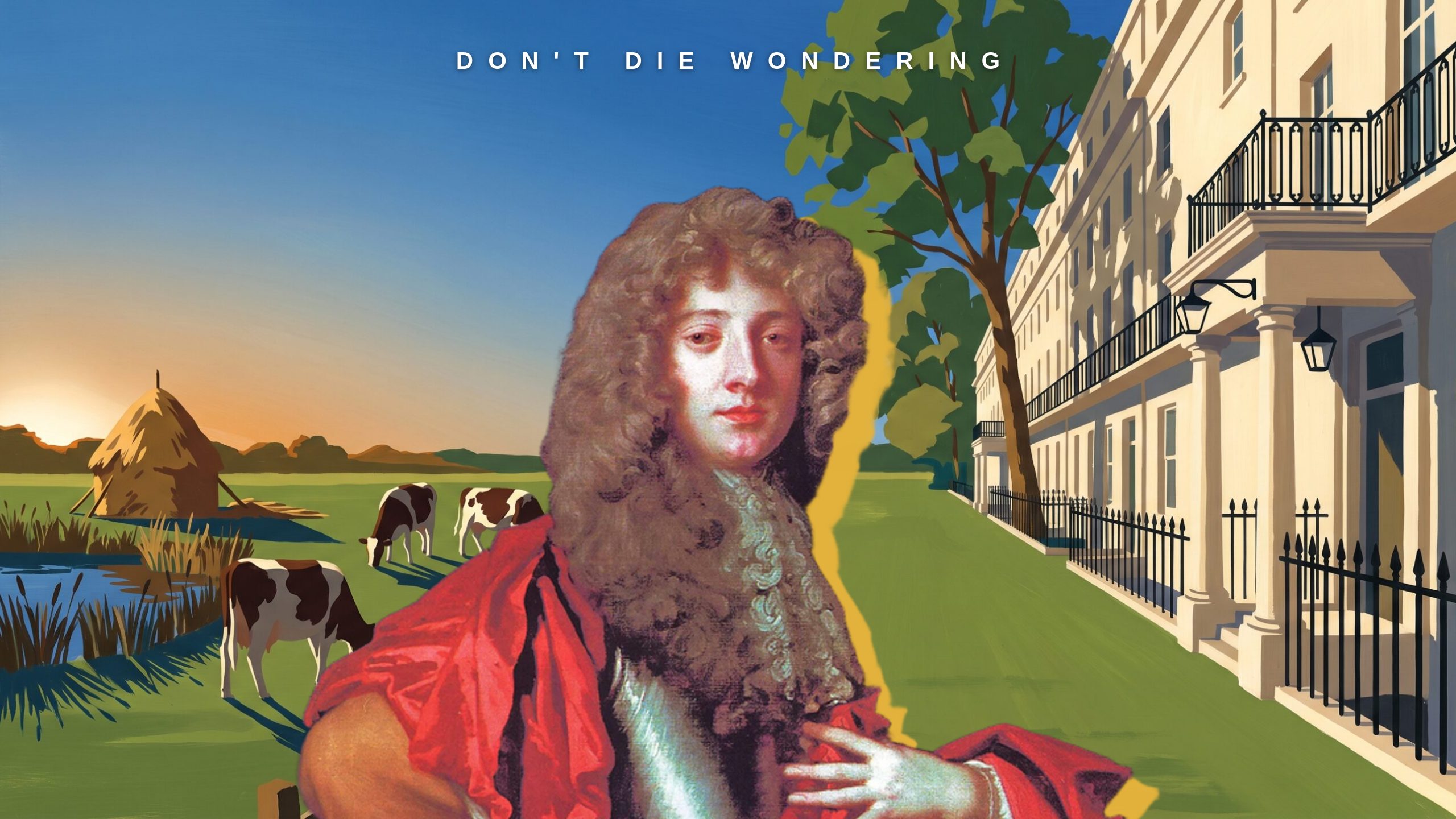
Five hundred acres of meadow and pasture, a twelve-year-old bride and a Cheshire baronet who took over another man’s £5,000 marriage contract: every square foot the Grosvenors own in London descends from that one transfer.
1665
Alexander Davies wrote other people’s contracts for a living. He was a scrivener in the City of London, he died in the Great Plague, and the daughter born to him that January inherited a manor of fields west of the city.
The land was the Manor of Ebury, which the historian Leo Hollis describes as some 300 acres of farmland running from the Thames up to what is now Oxford Street. The Survey of London and the Grosvenor Estate’s own account put the holding that eventually passed to the family at around five hundred acres. The two figures have never been reconciled, and nobody involved in 1665 had any reason to care.
Grosvenor’s own history describes the manor as reaching Mary through Hugh Audley, her great-grandfather, a clerk of the Court of Wards and Liveries. Other accounts give a different family relationship. Audley died in 1662, three years before she was born, having spent a career close to the machinery that decided who controlled other people’s inheritances.
1673
Her guardians found a buyer before she found a tutor.
By one account, repeated in the genealogical record but not independently verified, the family contracted her for £5,000 to Charles Berkeley, son of George, 1st Earl of Berkeley. Hollis dates a first betrothal to her seventh year. The Berkeley arrangement came to nothing, which is the only reason anyone now says the word Grosvenor rather than Berkeley when they mean the square.
1677
Sir Thomas Grosvenor had come into his own inheritance early and badly. According to London Remembers, his father was killed in a duel in 1661 and he succeeded as third Baronet Grosvenor in 1665, at Eaton Hall in Cheshire. His exact birth date is given as 1655 in some records and 1656 in others. He was about twenty-one when he took over the marriage contract.
Mary Davies was twelve years old. By modern standards this was a child marriage, and several of the historians who retell it say so plainly.
What she brought with her, in the Survey of London’s wording, was some five hundred acres of land, mostly meadow and pasture, a short distance from the western fringes of built-up London. One surviving account, again single-sourced, says the contract required that the couple not live together for a year.
He was buying grazing. Nobody in 1677 was buying Mayfair.
July 1700
Grosvenor died on 2 July 1700 at Eccleston, in Cheshire, having sat in Parliament from 1679 and raised a force for James II during Monmouth’s rebellion. His wife was eight months pregnant. A daughter, Ann, was born within the month.
They had eight children. Two sons, Thomas and Roger, died young; the other three took the baronetcy in turn, Richard as the 4th, Thomas as the 5th, Robert as the 6th. Robert went on to sit in the Commons from 1733 to 1755. Mary was thirty-five, a widow, and the legal owner of the fields.
1701 to 1705
The following June, in Paris, Hollis records that she was married overnight to Edward Fenwick, her chaplain’s brother, in circumstances disputed ever since.
Simon Jenkins, writing in The Oldie, describes what followed: Mary denying any knowledge of a marriage, her family rushing her north to the Grosvenor house in Cheshire while fighting off suggestions that she be certified a lunatic, and Fenwick issuing rental demands on Grosvenor properties along Millbank. Four years of litigation followed, with all London watching. A trial in 1703 was convened to establish what had happened in that hotel room, and, in Hollis’s framing of the questions put, whether she had been drugged and poisoned by the Fenwicks.
London Remembers records that the marriage was annulled in 1705 on the grounds that she was not compos mentis. That finding was the outcome of a case run by people with a direct financial interest in the answer, which is worth holding in mind. One historian’s reading, published on dukesandprinces.org, notes that Mary appears in the family histories in only two other contexts, her conversion to Catholicism in about 1695 and her going mad at around the same time, and suggests these may be two ways of telling a single story according to the prejudices of the period.
She spent the rest of her life under guardianship. Her trustees, and in time her son, kept building.
1710 to 1725
Sir Richard Grosvenor, born in 1689, turned his attention to Mayfair in 1710, keen to turn a profit on ground that had arrived through a marriage.
Systematic development began in the 1720s. Grosvenor Square was begun in 1725 and was, as Estates Gazette puts it, the largest and grandest the capital had seen. His mother lived to see her father’s farmland laid out in terraces under her husband’s surname. Mary Davies died on 12 January 1730.
1825 to 1953
The family moved south a century later. Estates Gazette records that the speculative builder Thomas Cubitt leased five fields in 1825 and started work; those fields became Eaton Square, Chester Square and the rest of Belgravia. Pimlico, developed later in the nineteenth century, was sold in 1953.
Writing in 2003, Estates Gazette put what remained at 100 acres of Mayfair and 200 acres of Belgravia, a figure that should be read as of its date rather than as a current measure. One big sale aside, the estate stayed where it was put.
The surname travelled with the fields, which is why Grosvenor still does particular work on an envelope.
1989
The first Sunday Times Rich List, published in 1989, ranked Gerald Grosvenor, 6th Duke of Westminster, as the second-richest person in the United Kingdom at £3.2 billion. Only the Queen was above him.
2016
The 6th Duke was worth an estimated £9.35 billion on the 2016 Rich List, in sixth place. He died suddenly that August.
His son Hugh was born on 29 January 1991 and baptised that June, with the then Prince of Wales among his godparents. He inherited at twenty-five, taking control of an estate the Sunday Times then valued at around £9 billion. In 2024 he married Olivia Henson at Chester Cathedral, in the county where the baronetcy began.
2026
The Rich List has moved the family around its upper reaches for a decade: £9.878 billion in 2023, £10.127 billion in 2024, £9.884 billion in 2025. The 2026 edition, published on 15 May, estimated the duke’s fortune at £9.677 billion, a fall of £207 million on the year.
Secondary accounts describe the wealth as held through trusts and estate entities, with the duke a beneficiary and chairman of the trustees, and the structure limiting what he can personally sell. The inheritance-tax advantages routinely attributed to that arrangement have been reported rather than set out in any public filing. In May 2026, wire reports suggested Grosvenor Group was looking to sell some £700 million of American property assets; the company has not confirmed it.
Grosvenor Group Limited was founded in 1677, the year of the wedding, and is registered at 70 Grosvenor Street, W1K 3JP. The headquarters sits inside the meadow.
Cover photograph: Peter Lely (1618-1680) via Wikimedia Commons (Public domain).