

Lady Eliza Mays-Smith rode, owned racehorses and, for a long stretch of years, held the ground on which a good portion of British racing did its morning work. She died in July 2026. On 17 July, Chaddleworth House was added to Rightmove by Knight Frank’s National Country Department, and by the first days of September Country Life had run the line that pushed a quiet Berkshire sale into the search charts: an estate bequeathed by William the Conqueror and owned by a Guinness heiress, on the market for the first time in 60 years.
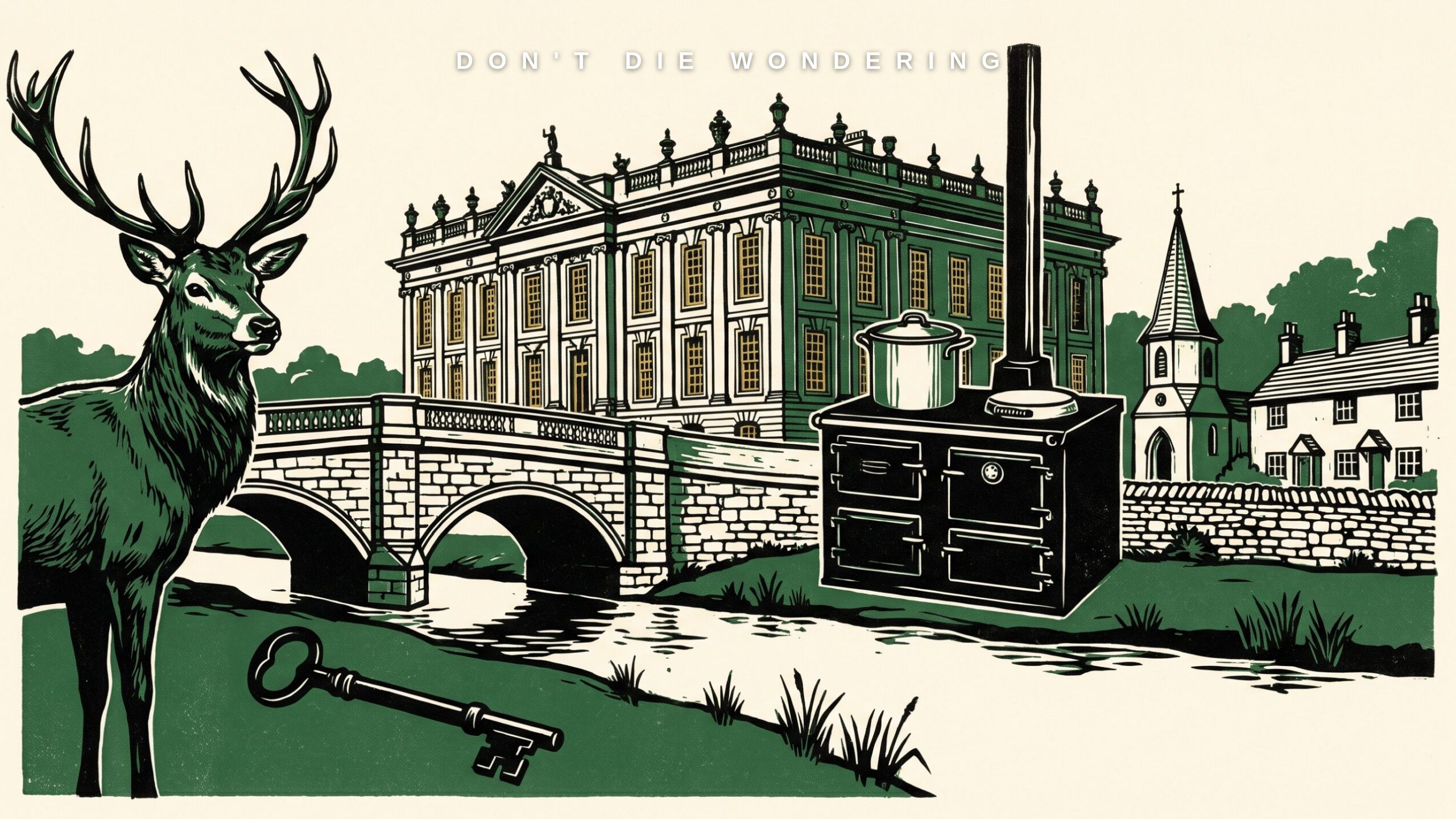
Two of those claims are straightforwardly checkable in the listing. The third belongs to the land rather than the building. The Conqueror gave away a manor; nobody has lived in what he gave away for a very long time. The house standing at Chaddleworth today is Regency, built between 1809 and 1811, and Grade II listed, which is the sort of distinction that matters enormously to a buyer and not at all to a headline.
The Land
Country Life’s account, by property correspondent Penny Churchill, traces the site to Robert D’Oyley, a Norman nobleman and landowner from Ouilly, near Lisieux, who took part in the Conquest and eventually held no fewer than 36 Domesday manors across six counties. From there the paper trail goes conventual: for much of the Middle Ages, per David Nash Ford’s Royal Berkshire History as cited by Country Life, the manor of Chaddleworth was held by Amesbury Priory in Wiltshire, granted the lands in 1284 by Henry II’s consort, Queen Eleanor, as a token of support for Eleanor of Brittany, who was one of the nuns.
After the Dissolution the manor eventually passed to William Nelson, a successful government lawyer whose family, Country Life reports, was to own it for more than 250 years. It was a Nelson, George Kerr Nelson, who built the present house between 1809 and 1811. His son sold the manor estate to the Wroughton family of nearby Woolley Park, another racing dynasty, many of whom were lord lieutenants of the county.
Racing, then, was on the premises long before the Guinness money arrived. Land does not have a memory, but its deeds do.
The Gallops
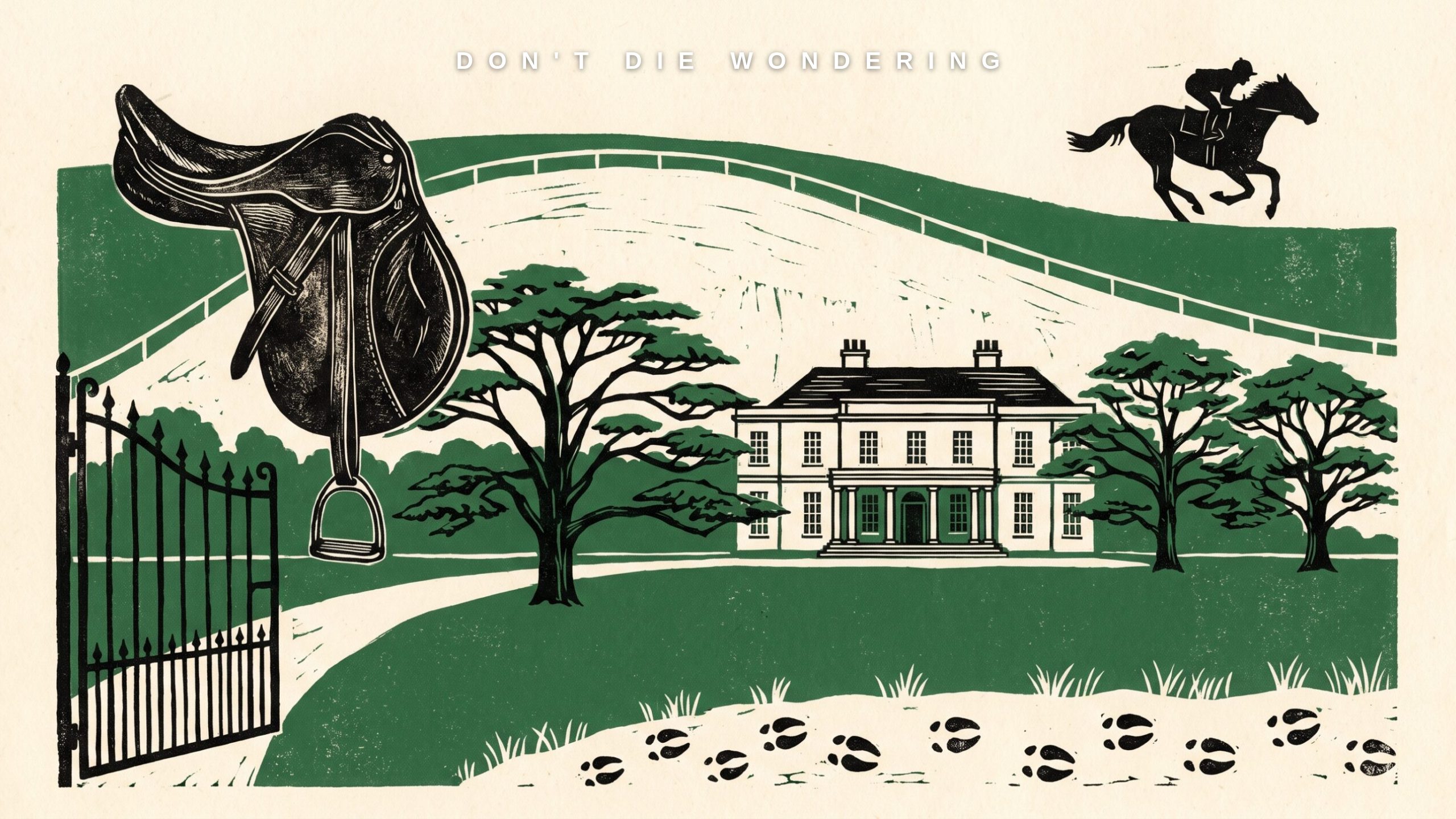
The part of Lady Eliza’s life that will be remembered locally has nothing to do with Norman barons. According to Country Life, she was a lifelong supporter of horse racing and is best remembered for her association with nearby Lambourn, where, for many years, she and her first husband, the late David Nugent, ran the racing town’s famous downland gallops, now owned by Jockey Club Estates. The charity HEROS, which lists her among its ambassadors, describes her more briskly as a racehorse owner and local landowner who used to own and keep the Lambourn gallops and has always been a keen racehorse owner and rider.
That is a particular kind of proprietorship. Owning a country house in west Berkshire buys you a view. Owning the gallops above Lambourn puts you, quietly, in the working life of every trainer within a morning’s hack, which is an influence no auction house can price and no listing can convey.
The house sits seven miles south of Wantage and 11 miles north-west of Newbury, on the southern slopes of the Berkshire Downs, in 31 acres of parkland on the edge of the village, inside the North Wessex Downs National Landscape. Knight Frank’s own copy calls it a compact Regency country house distinguished by its clean symmetry, classical detailing and well-preserved edge-of-village setting. Every word of that is doing work. “Compact” is the word that tells you it is a house rather than a project.
The Lineage
Country Life describes Lady Eliza as one of the heiresses of the great brewing dynasty and leaves it there, which is either discretion or deadline. The genealogical databases go further, and should be read as exactly what they are. Wikidata, drawing on The Peerage, records her as the daughter of Arthur Onslow Edward Guinness, Viscount Elveden, and Lady Elizabeth Cecilia Hare. Wikipedia records that same couple as the parents of Benjamin Guinness, 3rd Earl of Iveagh. The overlap points to a sibling relationship, but it rests on two genealogical database entries rather than a newspaper obituary, and no primary biographical source consulted for this piece confirms it. Wikipedia gives the current head of the family as Edward Guinness, 4th Earl of Iveagh; her precise relationship to him, if any, is not independently established in the public record.
The same databases record the shape of her private life: a marriage to David Nugent on 28 September 1960, a divorce in 1990, a second marriage to Robert Mays-Smith on 7 February 1992 that gave her the surname she died with, and four children from the first marriage, Charles, Hugo, Sheelin and Rory Nugent. A 2003 entry lists Chaddleworth House as her residence. No net worth, no probate figure and no estate valuation appears in any source consulted, and anyone quoting one is guessing.
There is also the small matter of the style. Country Life calls her Lady Eliza. Courtesy titles descending through a father who held a subsidiary title and predeceased his own father are governed by rules of considerable precision, and they are among the most reliable sources of correction notices in British journalism. We follow the house style of the magazine that broke the story.
The Price
The guide is £7 million, handled jointly by James Walker of Knight Frank and Ed Sugden of Savills, per Country Life. Two agencies on one Berkshire house is not a sign of difficulty; it is a sign that the executors would like the whole of the country market told at once, the racing buyers and the London buyers and the person who has been waiting eleven years for something Grade II, Regency and within reach of the M4 to come loose.
What it does not resemble is the last great Guinness departure. In 2017, Luggala, the family’s 5,000-acre estate in Co. Wicklow, went to market at a guide price of €28 million, £23.8 million at the time, in a sale Country Life described as heralding the end of 80 wild and wonderful years of Guinness family ownership. Different branch, different country, different order of magnitude. The two stories get folded together because both carry the same three words in the first line, and because a family that large produces a house sale roughly as often as it produces a wedding.
Chaddleworth is the smaller and, in its way, the more legible event. Sixty years is precisely the interval at which a house stops being an acquisition and becomes the thing the family is from. Nothing in the public record suggests dispute, contest or drama; there is a death in July, a listing in July, and a Country Life feature in September, in the order that country estates have always done these things.
No buyer has been reported. No offer has been announced. As of the beginning of September the house was still available, 31 acres of Berkshire parkland with a Norman footnote and a racing thread running through eight centuries of owners, from the Wroughtons to a Guinness who spent her mornings on the Downs.
The gallops now belong to the Jockey Club. The house is waiting on a phone call to Knight Frank.