


“Arthur Guinness was a philanthropist, a pragmatist, an innovator, a family man, and a fighter.” — the company’s own account of its founder
One of those five nouns arrives with a sheriff, a gang of Corporation workmen and a pickaxe attached to it. The other four are marketing copy. The fight, and the lease it was fought over, are the reason there is anything to market at all.
12 March 1725
The Dictionary of Irish Biography records Arthur Guinness as born 12 March 1725, the eldest of four sons of Richard Guinness of Celbridge, Co. Kildare, and his wife Elizabeth Read, who died in 1742. Richard was the estate agent and steward for the Rev. Dr Arthur Price, rector of Celbridge, a man who kept his north Kildare seat even after he was made bishop of Clonfert in 1724.
The date you will see on bunting is 24 September. At least one detailed account describes that one as a later choice, useful for anniversaries rather than documented in a register. The brewery that sells the pint is not always the best authority on the birthday.
1752
Price died, and the will did its work. Family tradition holds that Arthur Guinness was named after the doctor; what the Dictionary of Irish Biography confirms is that both father and son were handsomely remembered in it.
The sum usually quoted is £100. It appears in secondary retellings, among them The Vintage News, which adds that this amounted to roughly four years’ wages at the time. The DIB itself gives no figure. So the founding capital of the world’s most recognisable stout is, on the record, a word rather than a number: handsomely.
31 December 1759
He was thirty-four years old and taking on a ruin. The Irish Archives Resource, describing the Guinness Company papers, records that in 1759 Arthur Guinness signed a 9,000-year lease for the St James’s Gate Brewery at an annual rent of £45, and is blunt about what he was taking on: four acres, disused, with little brewing equipment.
The Irish Times inventory of the site is better still. There was a mill, two malthouses, stabling for twelve horses, and a loft that could hold 200 tons of hay. For £45 a year, in perpetuity minus a millennium, he acquired somewhere to keep the hay.
The landlord on the other side of that signature is named confidently all over the internet. It has not been confirmed here against the Guinness Archive or the Registry of Deeds, so it is left where it belongs, in the archive.
17 June 1761
Eighteen months into the lease he married Olivia Whitmore at Beaumont, Dublin. She was eighteen, her people were wealthy gentry, and her dowry was over £1,000, according to WikiTree’s genealogy citing the Oxford Dictionary of National Biography.
That single sum, as reported, was more than twenty years of rent on St James’s Gate.
By 1769
Within ten years of taking the lease, and against competition from imported English beers, Guinness was exporting to England. The Irish Archives Resource puts the achievement plainly, which is the only way to put it: a Dublin brewer, a decade in, selling into the market that had been selling to him.
In the 1770s he began brewing porter, the new dark English beer, alongside his ale.
16 May 1775
A Dublin Corporation sub-committee had already found, by 1772, that Arthur was drawing his water through two illegal pipes, larger than he was permitted. The city’s patience ran out three years later.
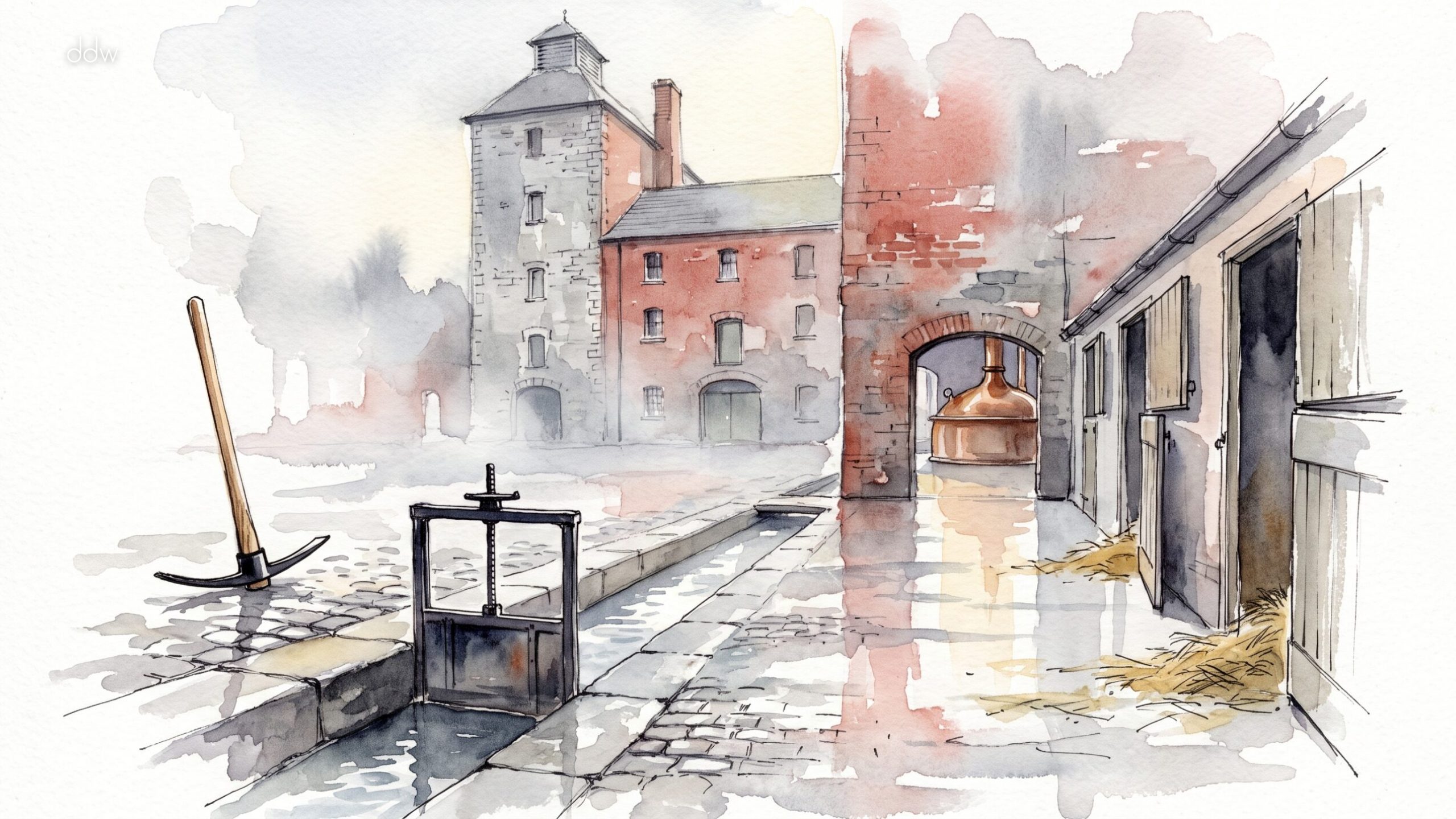
The Corporation arrived at the Back Course with the Sheriff and a body of workmen to fill in the watercourse between the Limerick property and St James’s Gate. As recorded in the Corporation and company histories and retold by the Dublin history site Come Here To Me, Guinness appeared, strenuously opposed them, told them that if they filled in the stream he would open it again, seized a pick axe from a labourer and stood in front of the workmen. The same histories, following Lynch and Vaizey’s study of the brewery in the Irish economy, note that he used “very much improper language”.
He was fifty, and he had been in business sixteen years. He kept the water.
24 May 1784
The settlement, as given by Come Here To Me citing Lynch and Vaizey, is the detail worth repeating at dinner: Guinness signed a further lease for the use of the water, for 8,795 years, at £10 a year. The term was not a round number because it was not meant to be one. It was the exact remainder of the original 9,000 years, so that the water and the ground would run out together.
There is one caution to enter here. A second secondary account places the final agreement in 1785 rather than 1784, and nothing located here settles it.
1799
He stopped brewing ale altogether. The porter had been successful enough, for long enough, that the older business was simply dropped.
Forty years after taking on four empty acres, he narrowed the product line to one.
23 January 1803
Arthur Guinness died at Beaumont, his country place, aged seventy-seven, and was buried in the Read family plot at Oughterard, Co. Kildare, according to WikiTree’s genealogical record. The same record, citing the Oxford Dictionary of National Biography, reports that he left a considerable fortune of £23,000 as well as the business. It is a single-sourced figure and has not been checked here against a probate record.
What the business itself was worth that January, nobody can tell you. No valuation of St James’s Gate as a going concern at the moment of succession appears in the archive description, the Dictionary of Irish Biography or any probate material found in this research. The most-described brewery in Ireland passed from father to son without a price attached to it.
His son, Arthur Guinness II, took over the brewery and all its operations. He expanded the export trade and introduced a beer called Extra Superior Porter.
1833, and 1855
The Irish Times dates the summit precisely: in 1833 St James’s Gate became Ireland’s largest brewery, passing its closest rival, Beamish of Cork. Seventy-four years after the lease, four acres of disused buildings had become the biggest thing of its kind in the country.
Arthur Guinness II died in 1855, and his son Sir Benjamin Lee Guinness took over, a succession confirmed both by the Irish Archives Resource and by Britannica. The family had by then left Celbridge far behind.
Richard Guinness collected rents for a bishop in north Kildare. His great-great-grandson, Arthur Edward Guinness, later Baron Ardilaun, was born on 1 November 1840 at St Anne’s, Clontarf, eldest son of a baronet and MP.