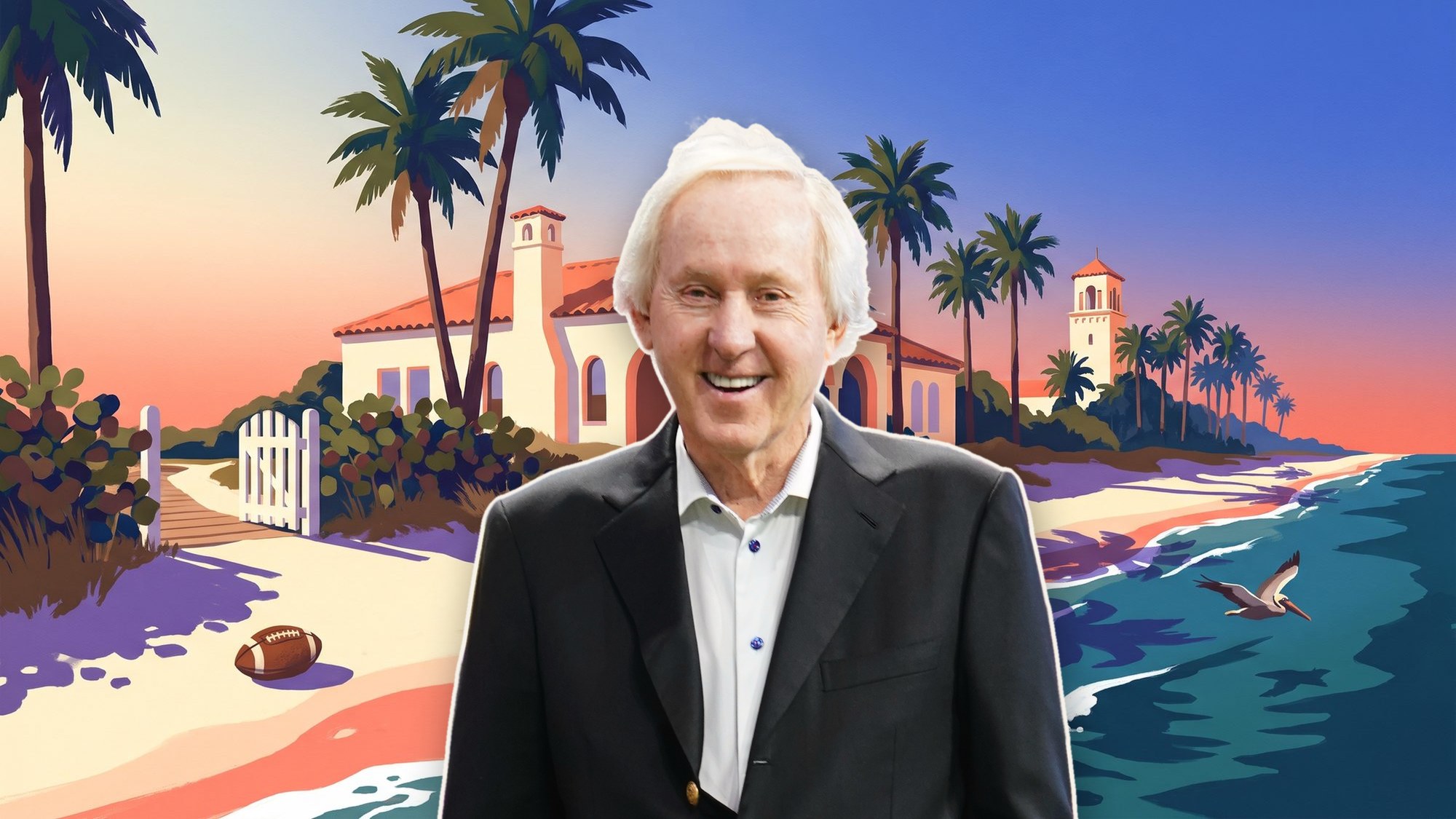




Julia Koch sold it to Ken Griffin, Ken Griffin has now sold it to Woody Johnson, and at 740 Park Avenue the music has stopped once more with an heir in the chair.
Musical chairs depends on a shortage. There is always one seat fewer than there are players, and whoever is left standing when the piano stops is out. The version played at 740 Park Avenue runs on different rules, because the players stay in the room and simply change seats. In the latest round, reported by Bloomberg on 17 November 2026, Woody Johnson, owner of the New York Jets and an heir to the Johnson & Johnson fortune, takes the duplex Ken Griffin bought last year, for $58m.
Bloomberg’s report rests on a person familiar with the matter. The founder of Citadel added a line of his own: in a statement, Griffin wished “Woody and his family many happy years in one of New York’s great residences”. It is a gracious thing to say about a home you have just sold. It is also a neighbourly one, as it turns out.
Whether the music has quite stopped is a matter of grammar. Bloomberg says Griffin sold. Robb Report, on 18 November 2026, says Johnson “has agreed to buy”, and adds that the duplex went off-market without ever being publicly listed. The Real Deal, the same day, names Ryan Serhant and Melissa Post of the brokerage Serhant as the agents acting for Johnson.
Three owners in twenty-one months
The seat Johnson is taking was warm when Griffin sat in it. Property records cited by Bloomberg show that Griffin bought the duplex from Julia Koch for $45m. The Real Deal, in a report of 9 April 2026, dates that purchase to February 2025 and counts 18 rooms, in a building it calls New York’s “richest building”. The Real Deal’s later report describes Koch as a socialite and the billionaire widow of David Koch.
By our count the duplex has found two buyers in twenty-one months, Griffin in February 2025 and Johnson this November. The gap between the two prices is gross, before taxes and costs, and anyone who has renovated so much as a kitchen knows how little the gross figure tells you.
What interests DDW is who sat where. Line the three owners up and a short history of American money falls out of the order. A widow, keeper of a fortune made by her late husband’s generation, sold to a founder, a man whose wealth comes from the firm he started. The founder has now sold to a great-grandson. On Park Avenue that is the natural direction of travel, with money starting new and growing older as it moves up the avenue. Here it went the other way.
Park Avenue likes to count tenure in generations; Griffin’s was counted in football seasons.
A Johnson & Johnson heir buys in
Johnson’s money is about as old as American consumer money gets. Bloomberg’s Billionaires Index profile gives his birth year as 1947 and describes him as a fourth-generation heir whose great-grandfather was one of Johnson & Johnson’s founders. The same profile records that he bought the Jets in January 2000, paying $635m to the estate of the oil baron Leon Hess.
Even that purchase had the shape of a family handing on a chair. Johnson did not buy the Jets from a rival or a fund. He bought them from an estate.
Bloomberg’s profile also records the public chapter. Donald Trump nominated Johnson in June 2017, Johnson having supported Trump’s first campaign, and he served as US ambassador to the United Kingdom until 2021. An ambassador lives, by the nature of the posting, in a residence that belongs to his government and passes to the next appointee. A Park Avenue duplex works on the opposite principle, and Johnson, now 79, is choosing one.
Admittedly, the purchase is a small line in a fortune of this age and size. Old money tends to buy rooms the way it buys everything else, without announcing it, through an agent, off the market. This deal followed that form exactly.
Griffin sells one and keeps one
Here the game gets more interesting, because Griffin has not left his seat so much as moved one along. Earlier in 2026 he paid $38m for a neighbouring duplex in the same building, Unit 4/5D, which The Real Deal reported in April. That deal was also off-market. Both buyer and seller sat behind shell companies, and Griffin was identified as the buyer a week after closing. In this building, anonymity keeps for about a week.
Robb Report says Griffin keeps that second duplex. So the founder of Citadel who has just sold at 740 Park is still a resident of 740 Park, as far as the paperwork reported so far shows.
DDW’s reading is that this is a man rearranging the furniture rather than leaving the house. He is giving up one large apartment in the building and keeping another in the same building, bought within the same eighteen months. Most people who want out of a place begin with the door.
A video outside Central Park South
There is another house in the background, and a mayor in front of it. In April 2026, Robb Report says, Mayor Zohran Mamdani filmed a video outside Griffin’s penthouse at 220 Central Park South, promoting a measure that would add an annual charge to certain high-value New York homes that are not their owners’ primary residences.

The Real Deal, in its report on the sale, draws the line from one to the other: if Griffin is going to be caught by a pied-à-terre tax, the outlet reasons, he is already shrinking what it would cost him. That is The Real Deal’s reading, and a tidy one. Griffin’s own statement on the sale is about the Johnsons and their happy years.
DDW reads it more cautiously. The measure Mamdani was promoting would charge owners, home by home, for second homes of a certain value, and Griffin still has a penthouse on Central Park South and a duplex on Park Avenue. If the sale was a tax decision, it was a partial one. A man fleeing a levy rarely keeps the apartment next door to the one he has sold.
The chair Johnson now holds
What Johnson gets, by the account of every report that has followed Bloomberg’s, is one of the large apartments in a building that has always treated its addresses as heirlooms. What he does with it is his business, and nobody has said.
What the trade shows is how small the circle is. Koch to Griffin, Griffin to Johnson, with Griffin also buying the duplex next door from a seller who, like him, was hidden behind a shell company until the reports caught up. The brokers moved in quiet, and the price was reported, not advertised. The building did what it does, which is to keep its seats full and its doors shut.
Julia Koch has left the game. Woody Johnson has a seat at the table. Ken Griffin is still in the building, one duplex along.
Read Next: Sergey Brin’s former Malibu home says nothing about the divorce
Cover photograph: Ralph Heimans via Wikimedia Commons (CC BY-SA 4.0).