

£1.8m in dilapidations, about £302,000 back, and a £1.5m balance settled from the King’s private money: Andrew Mountbatten-Windsor’s exit from Royal Lodge was paid for by his brother.
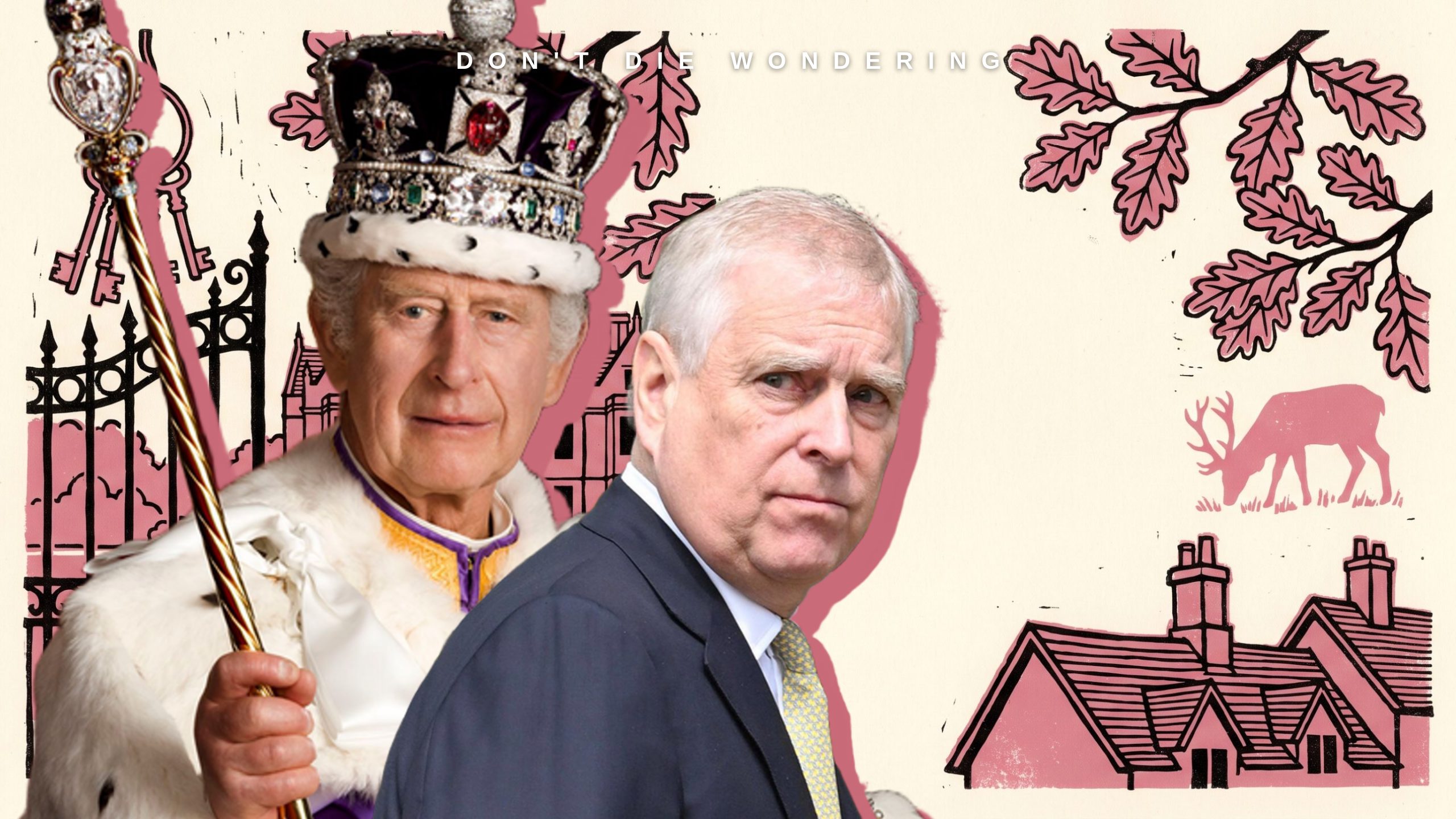
King Charles III has paid, from his private income, the repair bill left behind when his younger brother moved out of a rented house in Windsor.
The house is Royal Lodge, and the numbers are not gossip. On 9 October 2026 the Crown Estate confirmed the surrender of the lease more than 50 years before its 2078 expiry, and published the arithmetic itself: the former tenant “has fully vacated and paid £1.8m for dilapidations”, and was entitled under the lease to about £302,000 for surrendering within the first 25 years, a term written in to reflect the roughly £7.5m of refurbishment he funded at the start. Set one against the other and the landlord received £1.5m net. A lease signed in 2003 to run to 2078 ended twenty-three years in. Nobody handed Andrew Mountbatten-Windsor a cheque; the £302,000 he was granted for the end of the lease was swallowed whole by what he owed.
Then comes the part the Crown Estate’s statement does not cover, because it is not the Crown Estate’s business. The BBC reported that the net sum came from the King’s own pocket, and Town & Country understands that Charles made funds available from his private money to reimburse the Crown Estate. The Crown Estate is not the King’s to spend. It is held in right of the Crown, managed on behalf of the nation, and it does not write off a tenant’s obligations because the tenant has a famous surname. So the family paid, privately, to make the public landlord whole.
Twenty-three years and no monthly rent
The 2003 deal was the kind of arrangement that looks eccentric from the outside and perfectly rational from the inside. Andrew took a 75-year lease, made substantial payments up front, including about £7.5m on repairs, and in exchange paid no monthly rent on a house he occupied from 2004 until this year. Twenty-three years of occupancy, no monthly rent, and a clause that promised part of the entry money back if he left early. A peppercorn, for two decades, on a mansion in Windsor Great Park.
That structure is why the settlement looks the way it does. The lease treated his early money as an investment to be partially returned if he left young, and it treated the condition of the building on the way out as his problem. Both clauses fired at once in October 2026. The National Audit Office, which examined the royal leases, calculated the sums to the penny: according to GB News, citing the NAO’s work, Andrew would have been due £488,342.21 upon vacating the residence on 30 October 2026 without the need for end-of-tenancy work, and the lease’s early surrender clause could, in principle, have entitled him to a payment of £301,967.66 if the agreement ended without significant repair liabilities. The Crown Estate’s statement notes that the NAO found the royal leases were informed by independent, professional valuations and that the prices agreed sat within the recommended ranges. The paperwork, in other words, behaved exactly as paperwork should.
One further detail from that June 2026 investigation travelled quietly. The Royal Observer reported that the NAO disclosed an undisclosed private income to Andrew from subletting three cottages on the Royal Lodge estate, on a property where he had paid a minimal rent for more than twenty years. A sub-let is not a scandal. It is a landlord’s instinct, inside a tenancy that cost almost nothing to hold.
Nobody will call it a loan
Here is where the family firm’s accounting goes soft at the edges. Officials have not confirmed whether the King’s money was a loan or a gift, and no document has been produced that settles it either way. One account, attributed to palace sources speaking to The Times’s royal editor Roya Nikkhah, has it that the sum was structured as a loan to Andrew after his compensation was netted off, and that account reached most readers through secondary reporting rather than a primary document. No repayment schedule has been published, no interest terms disclosed, and no indication given of how a man whose independent income remains unexplained would repay £1.5m to his brother.
The silence is the point, and it is not clumsiness. A gift invites the question of why the sovereign is subsidising a private individual. A loan invites the question of when it will be repaid, and the answer would have to be a date. An unnamed transfer invites neither, and the Sunday Times Rich List 2026 puts the King’s personal fortune at roughly £680m, drawn chiefly from the Duchy of Lancaster, so the sum is survivable without being trivial. Rich families have always understood that the most expensive thing about money is having to describe it.
What the Palace has been willing to define is the boundary. Andrew Mountbatten-Windsor is the subject of a separate and continuing matter: Buckingham Palace has confirmed that the King is not funding his brother’s legal costs in the Thames Valley Police litigation, and reporting around the Royal Lodge payment states there is no connection between the two. In February 2026 he was arrested on suspicion of misconduct in public office relating to his years as a UK trade envoy; he has not been charged and denies wrongdoing. On 8 October 2026 the High Court heard that the search warrants used in February were issued under the wrong section of the Police and Criminal Evidence Act 1984 and must be quashed, a ruling about procedure that, as the police and the court record both make clear, does not end the investigation. The dilapidations are a landlord-and-tenant matter. The King’s money goes to one and stops at the other.
Nothing left for Beatrice and Eugenie
The lease was always meant to outlive its tenant’s occupancy. Seventy-five years to 2078, a peppercorn rent, and the expectation that the arrangement would pass to his daughters. Princesses Beatrice and Eugenie are the people for whom that long lease quietly functioned as a property settlement, and the surrender ends it. A term running to 2078 would have been theirs to use long after their father stopped living there. Royal Lodge belongs to the Crown Estate, so the property reverts in full; the estate agent Elliot Castle told the Mirror that once the lease is surrendered there is nothing to pass on.
Which leaves a large house in Windsor Great Park with a new purpose and an impatient landlord. The Crown Estate’s own language on 9 October was brisk to the point of comedy: “The lease for Royal Lodge has ended and our focus now is firmly on its future use and the opportunities to generate additional financial value for the nation from its early return.” That is a commercial body telling the market the stock is available. Hello! reports the place has the air of a ghost town since the move.
The move itself was managed in the style the last year has taught everyone to expect. The Sun first reported that Andrew left on a Monday in early February 2026, driven out “under the cover of darkness” to Wood Farm Cottage on the Sandringham estate in Norfolk, a long way from Windsor Great Park and a good deal smaller. Buckingham Palace had announced on 30 October 2025 that the King had begun the formal process of removing his styles, titles and honours, that notice had been served to surrender the lease, and that he would move to alternative private accommodation. Town & Country understands any future accommodation will be privately funded by the King.
It is the same brother and the same ledger, under a roof that nobody has to explain to the Treasury.
Cover photograph via Sky; via Cnn.