


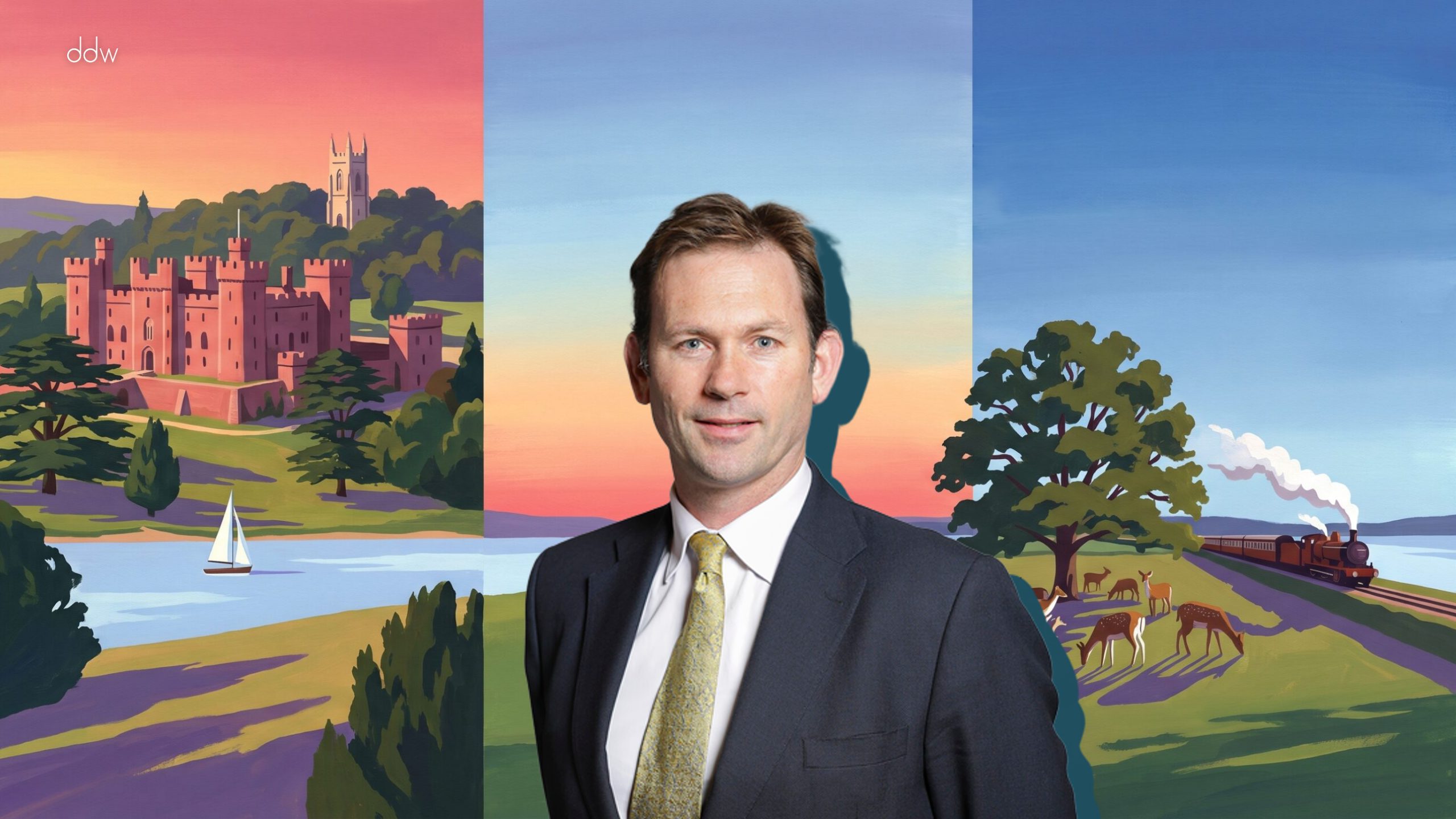
A Grade I castle on the Exe, about 3,500 acres by its own count, a Baywatch actress for a first wife and a Lords campaign against male primogeniture are all on the record, while the Earl of Devon’s total is not.
What is Charles Courtenay, Earl of Devon’s net worth in 2026?
The question has an awkward answer for a man with a castle. No serious outlet has put a figure on Charles Courtenay, 19th Earl of Devon. No serious outlet has published a valuation of Powderham Castle, its contents or its collection either. That has not stopped people searching. An earl with a Grade I seat and an American actress in his past is exactly the kind of man the internet would like to price.
Without a number, the sum has to be done the way a land agent would do it, from the outside in. That means the acres, the listing, the one famous sale and the trades that keep the roof on. Old families rarely publish accounts, but they do publish wedding brochures.
Who is Charles Courtenay, 19th Earl of Devon?
Charles Peregrine Courtenay was born on 14 August 1975. He is the only son of Hugh Courtenay, the 18th Earl, who lived from 1942 to 2015. Peerage News describes him as “of Powderham Castle” and a barrister. He succeeded to the earldom in 2015, on his father’s death.
The title is older than almost anything else in the conversation. According to Powderham’s own LinkedIn page, Empress Matilda created the earldom of Devon in early 1141. That gives the estate’s marketing department a twelfth-century empress among its references, which is more than most country-house wedding venues can say.
He sat in the House of Lords as a hereditary peer. When he spoke on the bill that would end that arrangement, he declared his interest “as the Earl of Devon”. It is a declaration that covers rather a lot.
Who owns Powderham Castle?
The Courtenays have owned it for a very long time, although the sources disagree on exactly how long. Powderham’s LinkedIn page says the castle was “established in 1391” and calls it the family home of the Earl of Devon. The Castles and Manor Houses guide gives a fuller account. The manor came to the family in 1325, in the dowry of Margaret de Bohun when she married Hugh de Courtenay, and Sir Philip Courtenay began building the castle in 1392. The house and its historians are a year apart. By the standards of medieval dating, that counts as agreement. Either way, Powderham has been the Courtenays’ seat since the 1390s.
The ownership itself is less well documented. DiCamillo’s Companion, an American reference guide to British and Irish country houses, says Powderham is personally owned by the Earl of Devon rather than vested in a non-profit trust. It gives the ownership type as “Individual / Family Trust”. That is a guidebook’s summary, not a legal record. How the land and contents are actually held, and what passes with the title, has not been set out in public.
According to the same guide, the castle first opened to the public in 1959.
How big is the Powderham estate?
That depends on whom you ask, and the Courtenays have not settled it themselves. Powderham’s own copy on its Historic Houses wedding listing says the castle is “surrounded by 3,500 acres”. In November 2023, the Daily Mail called the Earl heir to a 4,000-acre estate. Neither figure is official, and the gap between them is 500 acres, which is a good deal of Devon to mislay.
The firmest measurement comes from the state rather than the family. The Historic England entry for the registered park and garden records about 250 hectares: some 10 hectares of gardens and pleasure grounds and about 240 hectares of parkland and woodland on the Exe Estuary. The castle itself is listed Grade I.
Listing is the paradox at the heart of any valuation of a house like this one. It makes the building priceless and also very hard to spend.
How does Powderham Castle make money?
It makes money the way most surviving English seats do, by being useful to other people on their best days. The Castles and Manor Houses guide lists a deer park, educational kitchen visits and a farm shop. The castle also hosts wedding receptions, children’s parties, corporate events and private functions. Visit South Devon notes that it is licensed for civil marriages. On LinkedIn, Powderham puts its own headcount in the band of 11 to 50 employees, which is a self-declared range rather than a payroll.
According to The Times, the Earl and his first wife introduced yoga classes, nature walks and education programmes at the castle. A thirteenth-century manor learning to run a wellness timetable is perhaps the most modern thing about the place.
The best dinner-party fact about Powderham’s finances is a sale in which nothing left the building. In 1987, according to DiCamillo’s Companion, two bookcases by John Channon were sold through Christie’s to the Victoria and Albert Museum for £465,000. They remain at Powderham. That is a 1987 price and says nothing about what the collection is worth now. It does show the arrangement a family can reach when it needs the money more than the title deeds: the museum owns the furniture, and the castle keeps the view.
Who was the Earl of Devon married to, and who is Jemima Hannon?
His first wife is Allison Joy Langer, known as AJ, the American actress from Baywatch and My So-Called Life. The Daily Mail reported that they met at the Hard Rock Hotel and Casino in Las Vegas, and The Independent put the meeting in 2002. They married in the mid-2000s. Peerage News gives April 2004, while the Daily Mail gave 2005. It is a modest discrepancy for a family that dates its castle to the year.
They have two children, Lady Joscelyn Skye Courtenay, born in 2007, and Jack Haydon Langer Courtenay, Lord Courtenay, born on 16 August 2009.
In November 2023, the Earl filed for divorce in Los Angeles. The filing gave the date of separation as 30 September. The Daily Mail reported it on 7 November, citing irreconcilable differences. A statement issued on the Earl’s behalf asked that the family’s privacy be respected, and nothing in the public reporting goes further than that.
On 17 March 2026, Peerage News announced the engagement of Charles Courtenay to Mrs Jemima Hannon. She was born Jemima Alice Charlotte Ensor in August 1982. Her parents are Peter Ensor and the Hon Sarah Campbell, daughter of Baron Campbell of Alloway. Peerage News describes it as Lord Devon’s second marriage.
Why does the Earl of Devon oppose male primogeniture?
He has argued that if the Crown can change its succession rules, the peerage can too. On 25 March 2025, during the Lords debate on the House of Lords (Hereditary Peers) Bill, he moved amendments on gender parity, including Amendments 91 and 94, along with Amendment 97 on the name “House of Lords” itself. Hansard records the amendments in the day’s proceedings.
His case, made at another stage of the same bill, was simple enough to fit on an order paper. The Crown moved to gender-neutral succession in 2013, he said, so the same could be done for the “simple hereditary peerage”. He added that he had hoped to change the law while he still held a seat, but that this was no longer possible given his “pending abolition”. The Government replied that the issues deserved consideration but did not belong in this particular bill. Westminster has a long tradition of agreeing with a principle in a different bill.
The argument has an obvious domestic dimension, and it should be stated carefully. Joscelyn is the elder child, and Peerage News lists Jack as heir apparent to his father’s titles. That is the male-preference pattern the Earl has argued against in the chamber. The rule applies to the title, though. The estate is a separate legal matter, and how it will pass has not been made public.
Powderham’s own LinkedIn page has meanwhile been promoting the women in the castle’s history, beginning with the empress who created the earldom in the first place.
What did the Hereditary Peers Act 2026 do to the Earl of Devon?
It ended the arrangement under which he sat in Parliament. In March 2026, OPB reported that Parliament had passed the House of Lords (Hereditary Peers) Act, abolishing the 92 inherited seats in the upper house. The Earl had sat among the hereditary peers, so his own description of a “pending abolition” turned out to be accurate.
The Act removed the seats, not the titles. The Earl of Devon is still the Earl of Devon, and Powderham still calls itself his family home. For completeness, Scotland has a hereditary rank of its own outside the peerage: the Scottish barons, who in Scots precedence stand below knights and above esquires.
The net effect on his fortune is easier to state than the fortune itself. A seat in the Lords was never a line on any balance sheet.
Who will inherit the Earl of Devon’s title and Powderham Castle?
On the published record, the earldom goes to his son. Peerage News names Jack, Lord Courtenay, as heir apparent. The castle is a different question. DiCamillo’s Companion says Powderham is personally owned by the Earl, under an “Individual / Family Trust” arrangement, and that is the only published description of who holds it. Whoever eventually signs for the 3,500 acres, or the 4,000, will be named in documents nobody has yet made public.
Cover photograph: Roger Harris via Wikimedia Commons (CC BY 3.0).