



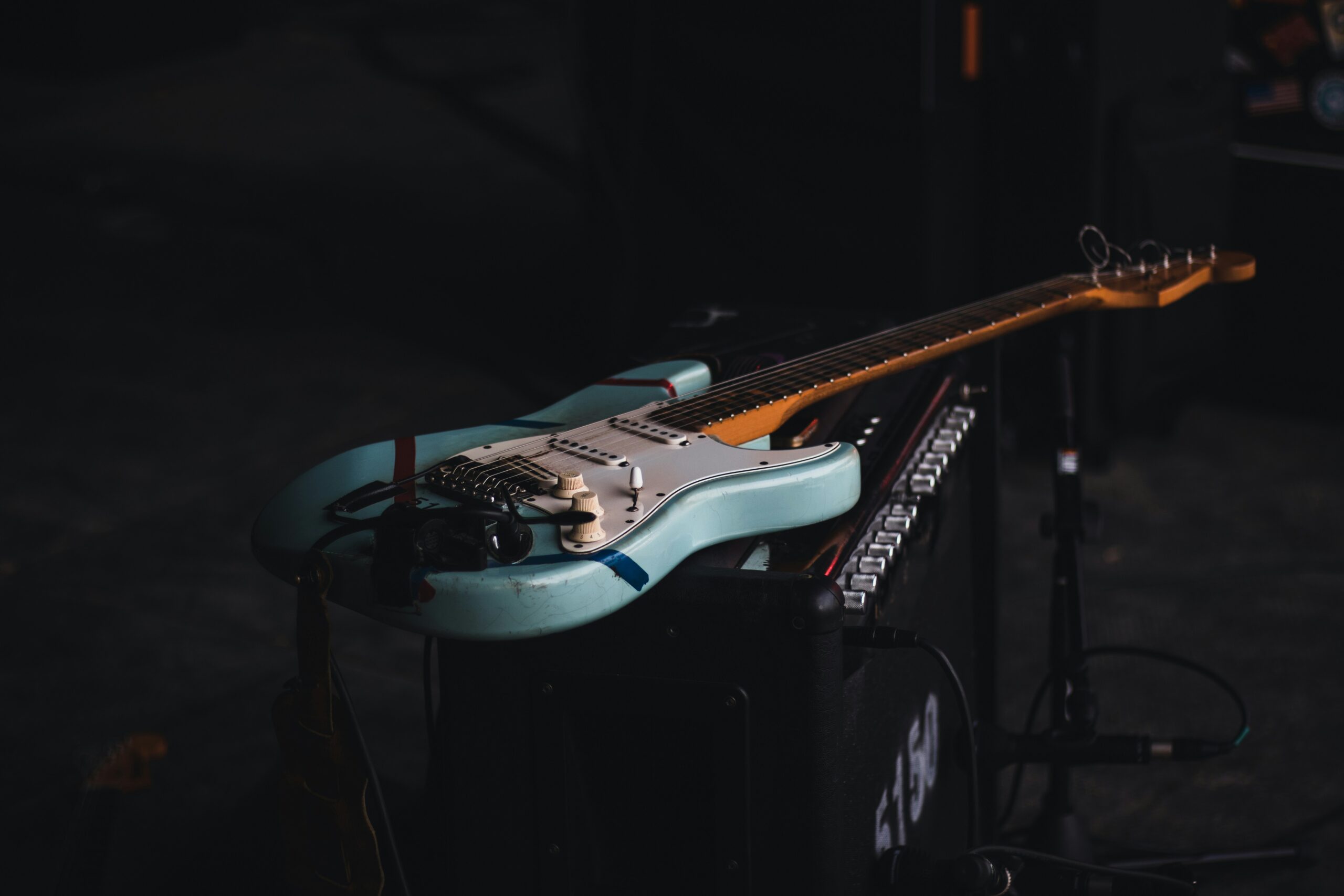
Banner image courtesy of Simon Weisser
Every guitarist carries a sound around in their head. Usually it belongs to a specific record: the dry crunch of an AC/DC rhythm part, the glassy Stratocaster sound on Sultans of Swing, the wall of fuzz on a Smashing Pumpkins chorus. And most of us have had the same evening with it. You sit down to find that sound, turn knobs for an hour, land somewhere vaguely nearby but wrong in a way you cannot quite name, and go to bed having decided the problem is your amp.
It almost never is. A surprising number of classic tones were made on gear that was ordinary or even cheap for its time. Seven Nation Army is a plastic-bodied pawnshop guitar. The Stairway to Heaven solo is widely reported to be a Telecaster into a small practice amp, not a Les Paul into a wall of stacks. What separates your Tuesday night attempt from the record is rarely the equipment. It is that the settings you found online describe somebody else’s rig, and settings mean nothing outside the rig they were set on. Treble at 6 on a Marshall is not treble at 6 on a Fender, and neither of them is treble at 6 on whatever you own.
So the productive question changes shape. Not “what were their settings” but “what was that rig doing, and what does mine have to do to match it”. That is a translation problem. You can have the translation done for you: ToneMirror will match any song’s guitar tone to your gear, knob by knob. But the logic behind the translation is worth knowing either way, because it is the same logic that rescues you every time your gear does not match the instructions. Here it is, in the order that matters.
Describe the sound before you touch anything
Chasing a tone by twisting knobs and listening is like navigating by driving around until things look familiar. Start instead by answering four questions about the sound in your head, in plain words.
Is it clean, just breaking up, or fully saturated? Where do the mids sit: pushed forward so the guitar barks, or scooped out so it glitters and booms? Is it compressed and even, or does it jump when the player digs in? And is the brightness coming from the amp or from the pick attack?
Write the answers down if you have to. A tone you can describe is a tone you can aim at. “Warmer” is not a setting, but “less treble, more mids, neck pickup” is three of them.
Use less gain than you think you hear
Records lie about distortion. Most big rhythm sounds are two or more takes stacked on top of each other, and the stack sounds far more saturated than any single take actually was. If you match the gain you think you hear, your one guitar ends up fizzy and small, because you are using distortion to do a job that was really done by doubling.
The AC/DC catalogue is the famous proof. Those rhythm parts feel enormous, and the amps are barely past clean. Set your gain where instinct puts it, then back it off until you can hear the individual strings in a chord again. That point, lower than feels right, is almost always closer to the record.
Forget the numbers on the knobs
Two amps with identical knob positions are not making the same sound, because the circuits behind the knobs are different filters. This is why copied settings feel cursed: you did everything right and it still sounds wrong.
The fix is to stop matching positions and start matching results. Play the record loud, play your guitar, and describe the difference in words: mine is brighter, mine is muddier, mine hangs on longer. Then move one knob at a time to close the gap you named. Your final numbers may look nothing like the magazine settings. That is fine. Nobody can hear your knobs.
Half the rig is in your hands and the guitar
The most underused tone controls are the ones on the guitar itself. The pickup selector changes the sound more than most pedals do. Rolling the guitar’s volume down a quarter turn cleans up a driven amp, which is the actual trick behind half the songs where one guitar seems to get two sounds. The tone knob, which most players leave on ten forever, is how you get from ice pick to smooth on the same pickup.
Then there is the hand. Picking hard near the bridge and picking gently over the neck are two different instruments. If the sound you are chasing has a soft round attack and you are hammering the strings an inch from the saddle, no amount of EQ will fix it.
When the gear cannot make the sound, match the job
Sometimes the honest answer is that your rig cannot make that exact noise. A single-coil guitar will not truly become a humbucker one, and a small clean amp will not become a cranked stack. This is where most players give up, and it is exactly where the translation gets interesting.
Ask what the part is doing in the song rather than what it sounds like in isolation. A fuzz you do not own might be there for sustain and weight, and a driven amp with the treble rolled down covers that job convincingly. A humbucker crunch chased with single coils wants the bridge pickup, mids pushed, treble eased, and a heavier pick. You will not clone the voice. You can absolutely cover the role, and in a room or a mix the role is what people hear. The side-by-side difference that torments you when you solo the guitar disappears the moment the bass and drums come in.
Try it tonight
Pick one song, just one, and give it fifteen minutes. Describe the tone in words before touching the amp. Set the gain lower than you want to. Shape the EQ to your description, not to anyone’s numbers. Pick the pickup, then play the part the way it was played, at the dynamic it was played at.
You will not land exactly on the record, because the record went through a studio and your bedroom did not. But you will usually land close enough to grin at, and you will have learned something no settings list can teach: what your own gear does, and how far it can travel. The sound in your head is not a product you have failed to buy. Most nights, it is a destination your gear can already reach, with you doing the driving.