


For about thirty years the top end of travel sold one picture: a white lounger, a turquoise horizon, and a waiter who had your drink order memorized by Tuesday. It worked because it was scarce. Then it stopped being scarce, every decent coastline grew its own glass-walled resort, and the people who had already seen all of them began asking what else was on offer.
What they found was dirt. Private ranches in Wyoming and Patagonia, coastal dunes in Namibia and Baja, cattle stations in Queensland the size of small countries, nearly all of it reachable by air and almost none of it by road. The land was always there. What changed was the willingness of landowners to build four suites instead of forty.
The result is a category that barely existed a decade ago and now books out a year ahead. Call it the high octane escape: small lodges, enormous terrain, and a garage that matters a good deal more than the spa.
Why the Beach Club Stopped Selling
Luxury travel has always run on rarity, and rarity moved. A seven-night beach stay is a known quantity, which is precisely its problem at the top of the market, because you can describe the whole thing in one sentence and nobody tells a story about a lounger.
Adventure operators caught the shift early. The best luxury getaways in Canada have been running this model for years, and those anchor properties show how far the idea scales, from tented wilderness camps on Vancouver Island to remote North Atlantic inns. Guests turn up wanting weather, distance, and a day that leaves some evidence on them.
The Terrain Sets the Terms
Private land is the real unlock. On a forty-thousand-acre ranch there is no permit queue, no shared trail, and no closing time, so an operator can build a day around light and conditions instead of around other visitors. That freedom is the actual product.
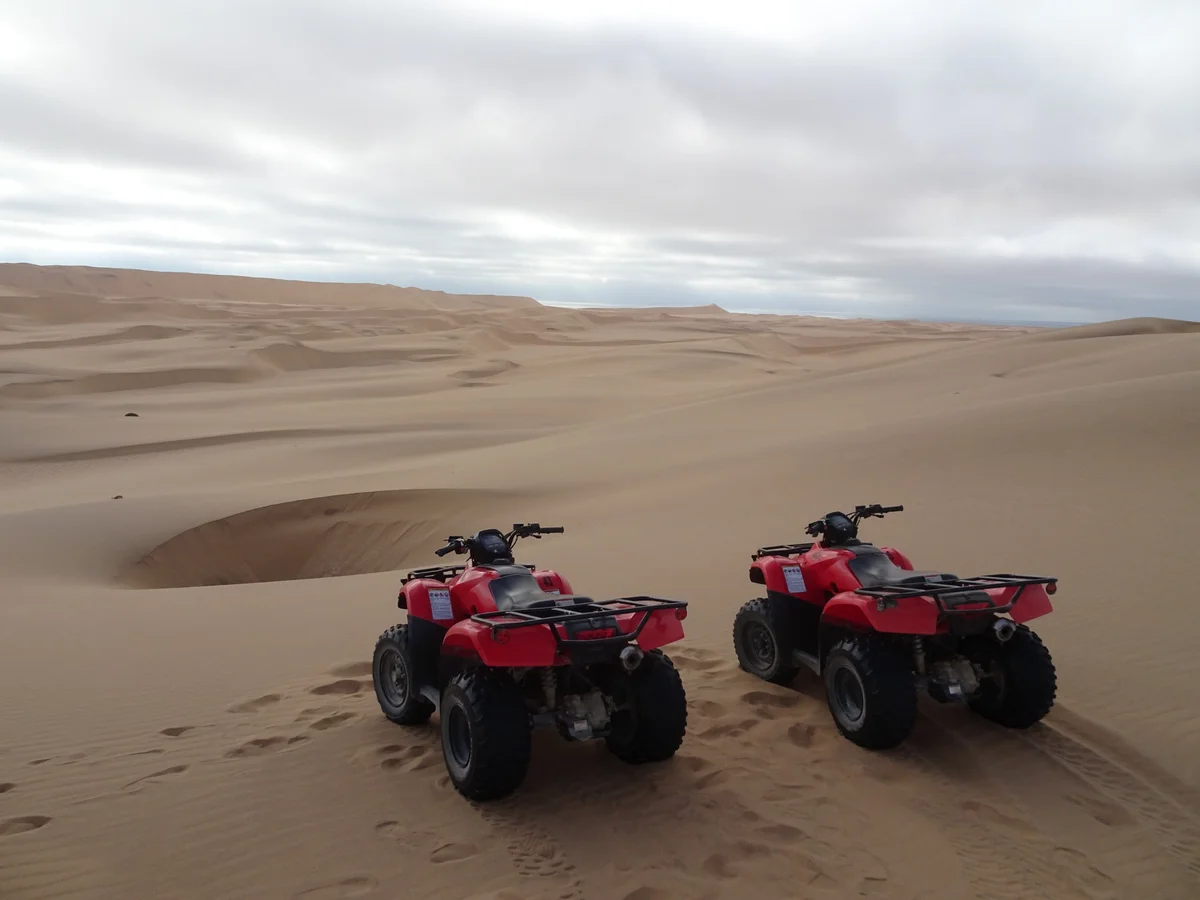
Coastal dunes deliver the same thing by a different route. Sand reshapes itself hour by hour with wind and tide, so a line that flowed beautifully at nine in the morning will fight you at four in the afternoon. Guests like that it cannot be scripted, and guides like that it keeps everyone paying attention.
Both environments are brutal on equipment. Fine sand finds every bearing it can reach, ranch two-track is a slow grinding abuse of suspension and wheels, and one unlucky water crossing fills whatever was not sealed properly. A lodge that cannot keep its fleet running does not have a program. It has a brochure.
The Machine Became the Centerpiece
Which is why the quad and the side by side have quietly become the signature vehicles of this category. A quad carries one rider at trail speed into country no truck can reach, it is quiet enough to get near animals, and it loads onto a boat or a small plane without a crane.
Operators at this level do not buy stock machines and hope. They buy a platform and rebuild everything that touches the ground, because that is where things break. Suspension gets revalved for load, intakes get raised, lighting gets swapped for something that survives vibration, and the wheels get more attention than any of it.
Where the Upgrade Actually Pays
Wheels are structural hardware that most buyers still treat as a styling decision. Every bit of torque the engine makes reaches the trail through the wheel center and the bead, and a cast wheel has a grain structure interrupted by its mold, which is a polite way of saying it cracks where it was never meant to flex.
That is the argument for fitting premium atv rims on a fleet that works for a living. A properly built rim holds its bead at low pressure in deep sand, survives a hidden rock on a ranch track without folding, and keeps its runout through a season rather than developing the slow wobble that tells a mechanic next week will be expensive.
Bead retention earns its own paragraph. Airing down is how you get flotation across sand, and low pressure is also how a tire starts rotating on its rim. Mechanical bead clamping takes that variable off the table, so a guide can drop to five psi at the dune line without doing arithmetic about valve stems.
Building an Escape That Holds Up
If you are choosing between operators, the fleet tells you more than the suite photography does. Ask what they run, how often they rotate it, and who services it, because an outfit two hundred miles from the nearest parts counter either keeps real spares and a real mechanic or improvises badly.
Ask about the terrain calendar as well. The best dune riding and the best high-country tracks have seasons, and an honest operator will tell you which eight weeks are worth flying for rather than selling you the same week twelve times a year.
The honest appeal of this category is friction. A beach holiday strips out everything difficult and hopes you enjoy the absence, while a dune field hands you heat, dust, a machine that wants your attention, and a view you reached under your own steam. People come home tired and talk about it for years.
None of it works without hardware that holds together. The guide, the terrain, and the light are what guests remember, and the bearings, the suspension, and the wheels are what make those things repeatable on day forty of a season rather than only on day four. Luxury out here is mostly competence, expensively applied.
So the lounger is not going anywhere, and plenty of travelers will keep choosing it, happily and without regret. But the growth is now well past the end of the paved road, where the drinks go warm, the dust gets into everything you own, and the thing being serviced after dinner is not the pool filter.