



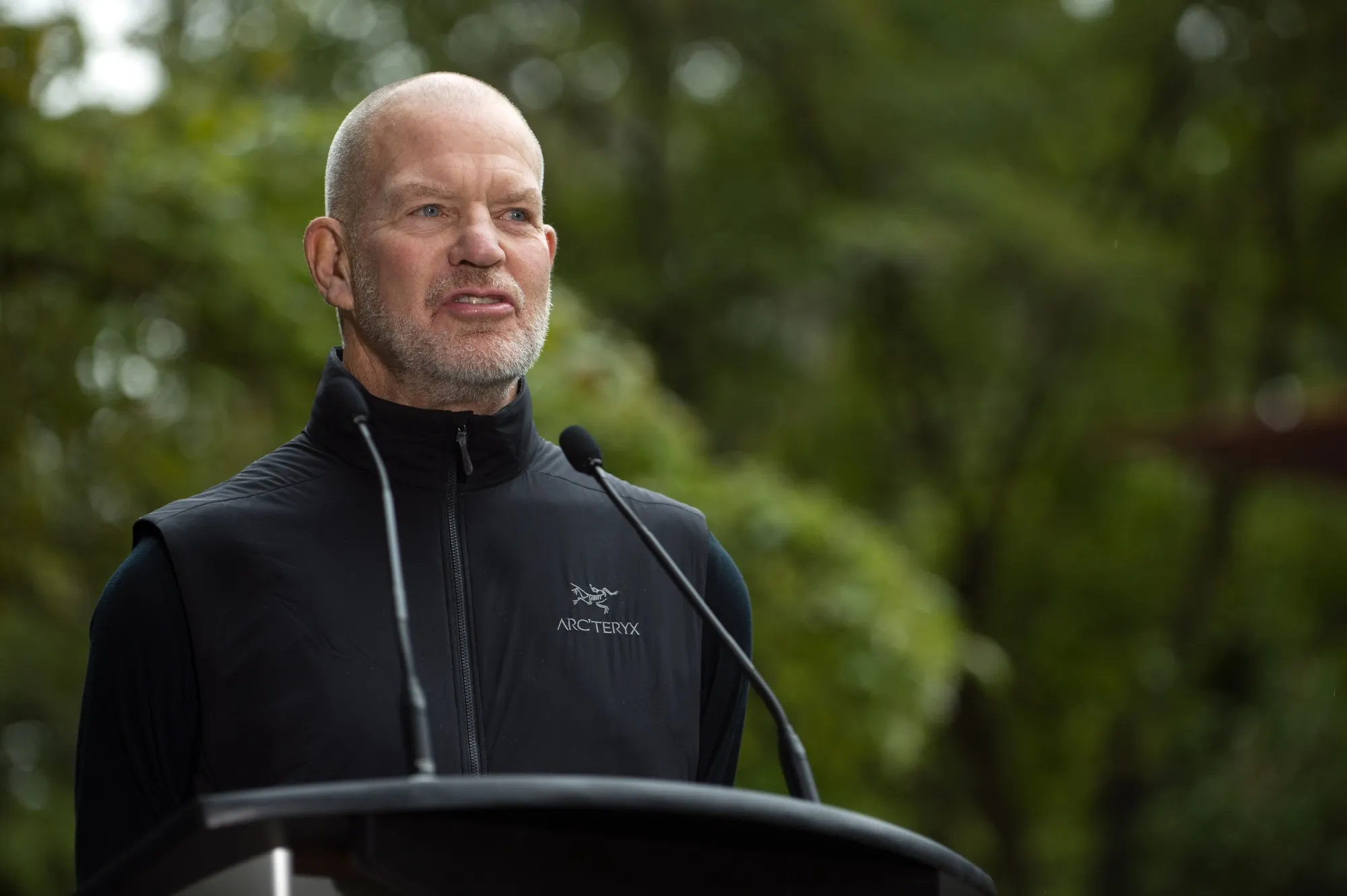
The most consequential document in Chip Wilson’s financial life is the one that was never drawn up. Bloomberg reported on 4 September that the Lululemon founder, 71, and Shannon “Summer” Wilson, 52, his wife and business partner of more than twenty years, are divorcing, and that they did so without a prenuptial agreement. Bloomberg’s Billionaires Index values him at $6.1 billion. The couple filed in April. Nobody outside the case knew until this week.
What is actually known, and what is not?
Proceedings were filed in the British Columbia Supreme Court in April 2026 and the file is sealed to the public and the press. That is close to the whole of the court record as anyone outside it can read it. No settlement terms, no valuation date, no requested relief, no grounds. Neither Chip nor Summer Wilson has said anything publicly about it.
The no-prenup detail comes from Bloomberg, citing two people familiar with the couple’s conversations. Everything else circulating this week is arithmetic performed on public shareholdings by people who have not seen the filing.
Why does a missing prenup matter this much?
Because without one, British Columbia’s family property rules apply to what was accumulated during the marriage. That is a general statement of law, not a forecast, and nobody who has actually seen the file is talking.
What makes the sentence interesting here is the calendar. Wilson founded Lululemon in Vancouver in 1998, helping to invent athleisure as a category. The couple married in 2002. The company went public in 2007. Almost the entire compounding curve, in other words, sits inside the marriage rather than before it, and the question of what was accumulated when is precisely the sort of thing family courts spend years and several sets of counsel resolving.
What does he actually own?
Chip Wilson still holds roughly 8.6% of Lululemon, worth close to $1 billion. He stepped down as chairman in 2013 after remarks about product quality and women’s bodies, left the board in 2015, and has spent the decade since as the loudest shareholder the company has.
The larger position is Finnish. In 2018 and 2019 he put somewhere between $800 million and $1.1 billion into the consortium that took Amer Sports private, the group behind Arc’teryx, Salomon and Wilson. Amer returned to the public markets in February 2024. Forbes valued his stake in January 2025 at about $3.2 billion, double its worth at listing; a BigGo Finance aggregation this month put his current holding at roughly 18%, worth near $3 billion. The number moves with the share price, as all of these numbers do.
The yoga pants made him famous. The Finnish ski and outerwear conglomerate made him considerably richer.
There is also a family holding company, Hold It All, which Forbes has described as operated by Wilson, his wife and their five sons, investing in apparel, real estate and private equity. BigGo’s aggregation refers to substantial property holdings including one of British Columbia’s most valuable residences; no specifics have been verified anywhere in the public record.
What did Summer Wilson build?
She was one of Lululemon’s earliest hires and its founding lead designer, which is a job title that undersells what it means to have drawn the first version of a garment that a generation wore daily. Chip has credited her with a large part of growing the brand into an $11 billion company. She holds roughly 1% of it, worth about $100 million, separately from his stake.
In 2014 she founded Kit and Ace, the technical luxury label, with her stepson J.J. Wilson. Both Wilsons left operational roles at Lululemon more than a decade ago.
Their joint work since has been philanthropic. They founded imagine1day in 2007, aimed at primary education in Ethiopia, and in September 2022 gave C$134 million, about $97 million, to the BC Parks Foundation through their family office, House of Wilson. The charity called it the largest private donation in Canadian conservation history.
Why is the timing awkward for Lululemon?
The company cut its full-year sales outlook and the stock fell more than 17% in a single session, hovering near an eight-year low, according to reporting collated by AllWeather Finance. Heidi O’Neill, formerly of Nike, is scheduled to take over as chief executive on 8 September.
So the news of a founder’s divorce, involving a stake worth close to a billion dollars, arrives in the same fortnight as a guidance cut and a new boss. Nothing in the record connects those three events to one another. Calendars do not always cooperate.
What do older fortunes do differently?
They sign things early, when the paperwork costs nothing because the asset is worth nothing. A shareholders’ agreement drafted over a Vancouver snowboard shop in 1998 is a formality. The same conversation in 2026, with an 8.6% position, a Finnish conglomerate and five adult sons in a holding company, is a litigation strategy.
Inherited money tends to arrive pre-wrapped: trusts, classes of share, holding vehicles that own the asset so no individual has to. Founders build the asset first and the structure afterwards, if at all, and the reason is not carelessness so much as sequencing. Nobody incorporates protection around a business they are still trying to keep alive. The Wilsons did eventually build the apparatus, Hold It All and House of Wilson among it, but a family office is a machine for deploying wealth, not for defining whose it is.
The instinct to paper the downside usually shows up one generation after the money does.
What happens next?
The matter is contested and unresolved, and the file stays sealed unless a court decides otherwise. Any movement in Wilson’s Lululemon or Amer Sports holdings would eventually appear in filings, which is the only place this story will produce hard numbers rather than estimates.
Until then the public record of a twenty-four-year partnership consists of a company, a brand, a nonprofit in Ethiopia and a parks donation. Everything currently at issue is behind a seal in British Columbia.
The one document anyone can still read is the C$134 million gift.
Cover photograph: Francis Georgian via Yahoo.