




Banner image courtesy of Amber Jacqueline
There is a reason the most sociable part of any well-designed kitchen is not the table in the other room, but the island, the breakfast bar, the counter where people drift when you are cooking and end up staying through dinner. The bar stool is what makes that possible, and yet most people buy them as an afterthought, squeezing in whatever fits the height and budget without much further thought.
That is a mistake worth correcting.
The kitchen has been quietly displacing the dining room as the true social center of the home for over a decade now. According to the National Kitchen and Bath Association, about half of designers report that clients are opening floor plans around a maximized island rather than a formal dining room, and 20% of respondents identified the traditional stand-alone kitchen table as an outgoing trend. Meanwhile, the 2024 Houzz Kitchen Trends Study found that 54% of homeowners use their renovated island for entertaining, and 44% for socializing. The island is where the action has moved.
Height First, Everything Else Second
The number that matters most when choosing bar stools is the gap between the seat and the underside of your counter, which should sit between 10 and 12 inches for comfortable legroom. Work backwards from there.
Standard kitchen counters and islands run 35 to 36 inches from the floor, which calls for a counter stool with a seat height of 24 to 26 inches. A dedicated home bar surface runs 41 to 43 inches, requiring a standard bar stool seat height of 28 to 30 inches. A measurement error of just two inches can result in cramped knees or an awkward reach that makes the entire setup feel wrong. Measure before you look at anything else.
Each stool needs 21 to 24 inches of linear counter space. This is where people routinely miscalculate, cramming an extra stool into a run that would seat three comfortably and ending up with five people who cannot move their elbows. Fewer stools, properly spaced, will always look and function better than the maximum the surface will technically hold.
The Case for Swivel
Stationary stools have a cleaner visual profile and slightly simpler construction. For a formal bar setup where people sit down, face forward, and stay there, they work fine.
For a kitchen island used for actual socializing, the swivel function earns its place. It allows the person seated to turn toward a conversation without physically repositioning the stool, which makes the seating feel genuinely relaxed rather than slightly awkward. This is the difference between a seat that encourages people to linger and one that subtly nudges them toward standing up.
The tradeoff: swivel stools need more clearance around them than stationary stools, since the seat rotates outward as someone sits, turns, or stands. If the island is tight against a wall or adjacent to high-traffic walkways, factor that into the layout before committing.
Material and the Long Game
The stool you buy for a kitchen island is going to be sat on, climbed on by children who should know better, leaned against, and wiped down after every dinner party. It is not decorative. It is structural. The material needs to perform accordingly.
Powder-coated steel frames are the most forgiving under consistent use. They do not warp, corrode, or loosen at joints the way cheaper alloys do, and they take a range of upholstery types without compromise. Solid wood frames carry more visual warmth and age well if the wood is properly finished, though they are slightly more susceptible to humidity over time.
For the seat itself, the choice is between upholstered and non-upholstered. Non-upholstered stools are easier to clean and more honest about their purpose — they are perching spots, not armchairs. If the island is primarily a quick-breakfast-and-coffee situation, they are the right call.
Upholstered seats invite longer stays and add visual softness to what is usually a hard-surfaced room. Leather is the most practical choice for a kitchen environment: it does not absorb spills, wipes clean quickly, and develops a patina over time that fabric never manages. Performance fabric is the second option, purpose-built to resist staining and maintain its appearance through heavy use.
The stool that looks the most minimal at the point of purchase will often look the most considered in the room. Overly ornate designs compete with the cabinetry and countertop rather than working with them.
The Detail That Ties the Room Together
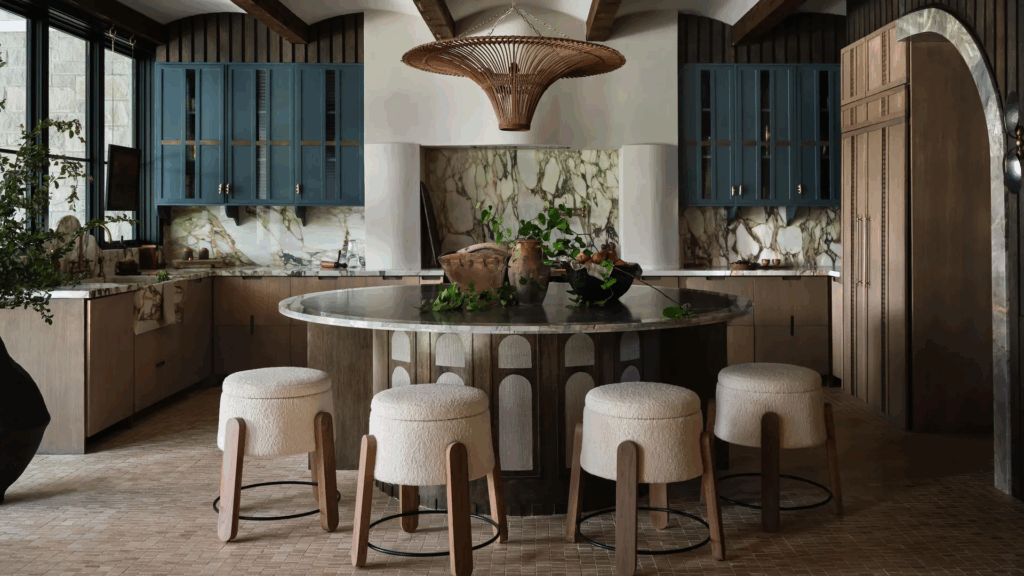
There is an argument to be made that the bar stool is the most design-critical purchase in a kitchen renovation, precisely because it is the element most people treat as an afterthought. The countertop, the cabinetry, the appliances — all of these are chosen with care. Then, with the big decisions made, a set of stools gets ordered quickly to fill the space.
The result is kitchens that look almost right. Almost considered. The stools are fine but do not quite belong; the heights are slightly off; the finish does not quite read with the hardware.
Interior designer Brad Ramsey has noted that positioning bar stools opposite each other on a longer island completely shifts the atmosphere, turning the space from a breakfast bar into something that feels more like a gathering table. That level of thinking about how the seating actually shapes the social dynamic of the space is exactly the right frame for the decision.
Buy the stool that fits the measurement. Choose the material that will outlast the trend. Think about whether swivel earns its place in your specific layout. And treat the choice with the same seriousness as anything else in the room, because the bar stool is not supplementary. It is where people actually sit.


