

As Hugh Hefner himself put it in Hef’s Little Black Book, “One of the key moments in my life was the discovery that I could get away with wearing pyjamas most of the time,”.
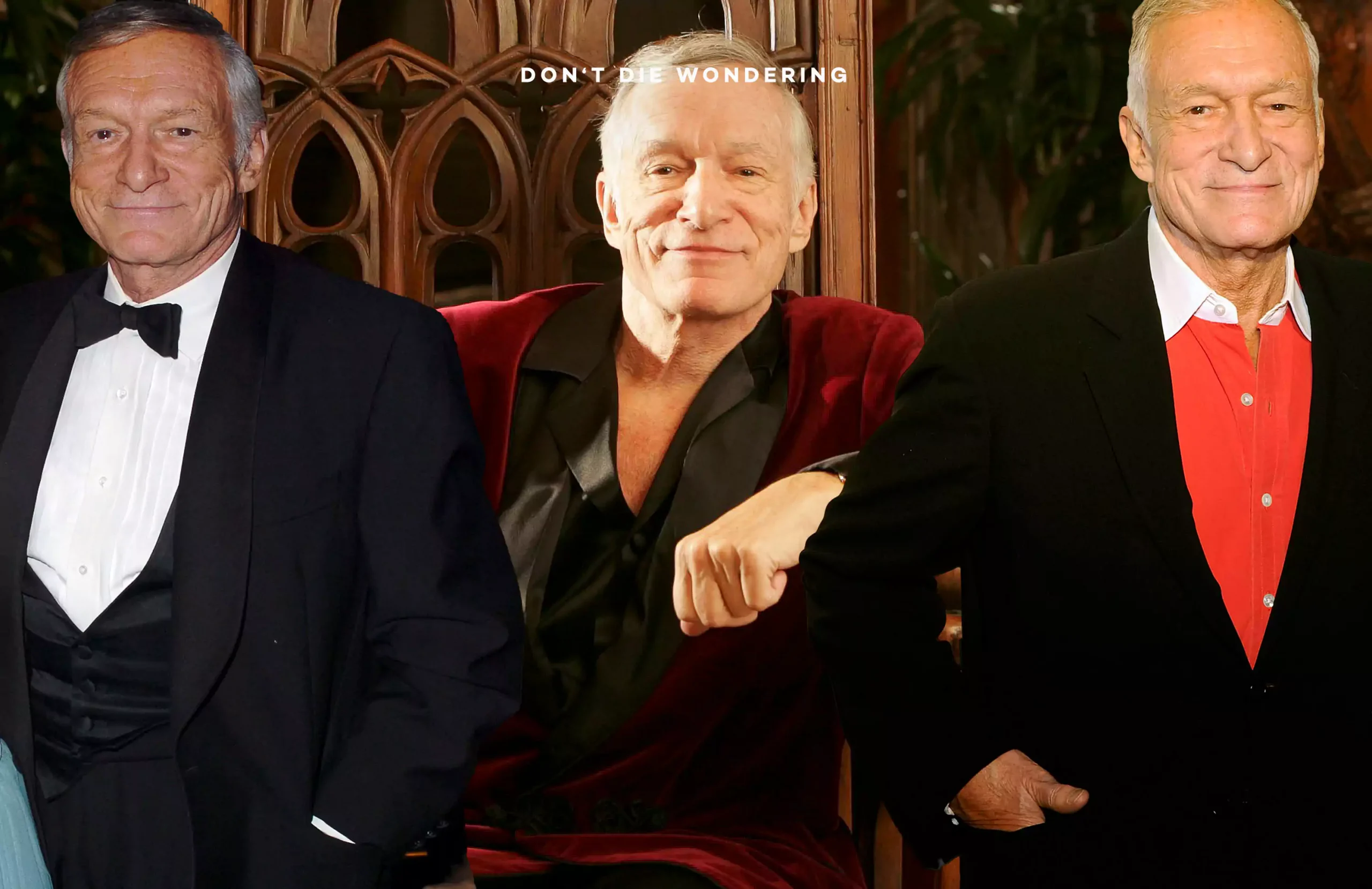
It doesn’t matter if you know absolutely nothing about the Playboy mogul Hugh Hefner, because at some point you will have crossed paths with some photographs of him dressed in a deep-red silk gown. That’s just the image he has carved for himself; Hugh Hefner is a man in pyjamas surrounded by beautiful women.
“My favourite outfit consists of pyjamas and a custom-made smoking jacket,” Spoke Hefner for the Daily Mail in 2007. “I have 200 pairs of silk pyjamas. I always wear black during the day – black is serious, for taking care of business.”
:quality(85)/cloudfront-us-east-1.images.arcpublishing.com/infobae/FSM4HU7QU5FIXCZZI4RP3KO4BI.jpg)
This so-called obsession with pyjama wear began in Playboy magazine’s early days. A true businessman to his core, Hugh Hefner often worked tirelessly around the clock, often finding himself swamped in work in the late hours of the morning. Pyjamas, thus, became an obvious attire for the late-hour workaholic.
Without a stylist and no idea how much everything costed, Hugh dressed himself for years. His most iconic dressing gown became the deep red silk one, complimentary to his smoking pipe and greyed-out hair.
Of course, the loungewear was great for the hedonistic image of Playboy. Born out of Hugh’s very sexual frustrations, fruit of a strict upbringing where sex was never spoken about, Playboy was, in a way, Hefner’s way of coming to terms with adult pleasures.
When Hefner was forced to scrub up, he actually did so in custom cuffed Armani suits, in deep shades of garnet paired with silky blacks. In fact, he owned 35 custom Armani pieces. As Hefner said to the Daily Mail, he is “probably the only guy in town who has Armani suits with turn-ups. It’s a connection to my sense of tradition and to the time when I was growing up before World War II.”

When it comes to shoes, Hefner didn’t spare on comfort either. Realising that through his sheer privilege he could get away with pyjama wear all year round, he often chose loafers to compliment. Made in black velvet, his 12-pair collection was custom-made by Di Fabrizio in Los Angeles.
Although Hefner passed away in 2017, his legacy of unapologetic loungewear lasts. A fashion icon particularly in times of pandemic, when loungewear saw an impressive rise in the fashion world, Hefner’s silk dressing gowns remain a distinctive Playboy reference and are likely to do so for years to come.
Updated July 2026
Hefner’s uniform has outlived him, and, if anything, it has become more legible as a brand asset than it ever was as personal style.
In June 2025, PLBY Group formally renamed itself Playboy, Inc., a cosmetic correction that reasserted the original fantasy: Playboy is not a media company, but a lifestyle. The message was clear—Hefner’s world still sells, even without Hefner.
That tension surfaced more explicitly in October 2024, when Cooper Hefner attempted to buy back the Playboy brand and its intellectual property for over $100 million, positioning the move as a return to “roots.” The offer was declined. What remains, then, is a peculiar arrangement: a deeply personal aesthetic—one man’s cultivated image of leisure, control, and access—held and managed as corporate property.
Meanwhile, the wardrobe itself has entered a second life as an artefact. Auction houses such as Julien’s now regularly circulate Hefner’s silk pyjamas, smoking jackets, and monogrammed slippers, itemising what was once a deliberately repetitive uniform. The effect is almost ironic. Clothing designed to signal effortlessness now accrues value through provenance and scarcity; the costume of permanence becomes collectible, precisely because it is no longer worn.
Yet the image cannot be entirely separated from the man.
Since this article first ran, Hefner’s legacy has been more openly contested, notably through the Secrets of Playboy docuseries and, more recently, disputes surrounding the stewardship of his personal archives.