
It costs £30. Your phone gets sealed. The building is being demolished soon. Soho hasn’t felt this unpredictable in years.
Banner image courtesy of Aleksandr Popov
If I’m being totally honest, gone are my days of weekly clubbing. Queuing for an often bored-looking bouncer to glance at my ID (because yes, I take pride in still looking under 25 with the right make-up on), only to arrive at a dingy, dark basement with either incessant techno or radio hits doesn’t quite hit the spot like it used to a few years back. But last weekend I decided to make an exception for the mysterious new kid on the block: Lost.

I’m pretty sure the premise of me even writing this goes against what Lost is all about. Veiled in mystery, the club has become the capital’s hottest (and most central) nightlife obsession, with queues to get in wrapping all around the old Odeon cinema the building is located in.
Soho is an odd location for this club, especially one as ‘artsy’ as Lost. It would be a thousand times more fitting for the club to be held in some warehouse in East London, but its central location does encourage the crowd from being a real mixture. From university exchange students to an old couple in their 70s, it was the closest I have been to such a diverse crowd since Glastonbury.
Whilst there is no dress code (at least not that I am aware of), there is a price tag of £30 to be paid at the door. If that makes you wince, I strongly recommend you re-consider: It is worth it. Also at the door, your phone will be wrapped up inside a fabric case, sealed with a stapler of sorts and only openable once you leave the premises. Whilst this is not too uncommon (Berghain, Fold or any underground club have banned photography for years), having one’s phone completely sealed and taken away is a new one.
The £30 isn’t just entry, but curation tax. You’re paying for friction: for the privilege of not being able to slide in and out, check your notifications, or treat the night like background noise. In a city where everything is optimised for speed and screenshots, Lost sells slowness and presence, and somehow that feels almost… luxurious.
For the first fifteen minutes, I kept instinctively reaching into my bag. Phantom limb syndrome, but for dopamine. There’s something unsettling about not being able to check the time because you’re used to measuring experience against it. How long had we been there? Is it too early to leave? Is it socially acceptable to be this sweaty at 1am?
Without a screen to retreat to, every lull stretches. There’s no emergency scroll, no discreet exit into Instagram stories if the DJ set dips. You either commit to the moment, or you stand there fully exposed in it.
And oddly, that exposure starts to feel… clarifying.
You begin noticing things you’d usually flatten into background: the way strangers actually hold eye contact for a second too long, the choreography of people navigating narrow corridors, the subtle shift in energy when a room realises the music has changed. Even boredom — the micro-second version of it — becomes visible. And because you can’t anesthetise it with a scroll, you move. You wander. You look for something else.
It’s difficult to admit, but most nights out are structured around soft escape routes. Lost removes them. The night doesn’t fragment into documentation; it accumulates. Time becomes elastic. And at some point — without knowing when — you stop missing your phone entirely.
And so without a phone, without being able to tell the time, or text my partner, we began getting lost.

As I mentioned, the club is tucked inside an old Odeon cinema, reportedly due to be demolished in the coming months. It’s a neat example of the city’s latest favourite planning buzzword, meanwhile use: the practice of giving a building a last, temporary life while the developers, paperwork, and money shuffle into place. In theory it’s pragmatic and even civic minded. In practice, it can feel like London’s emotional support strategy for the fact that everything good is always “closing soon”.
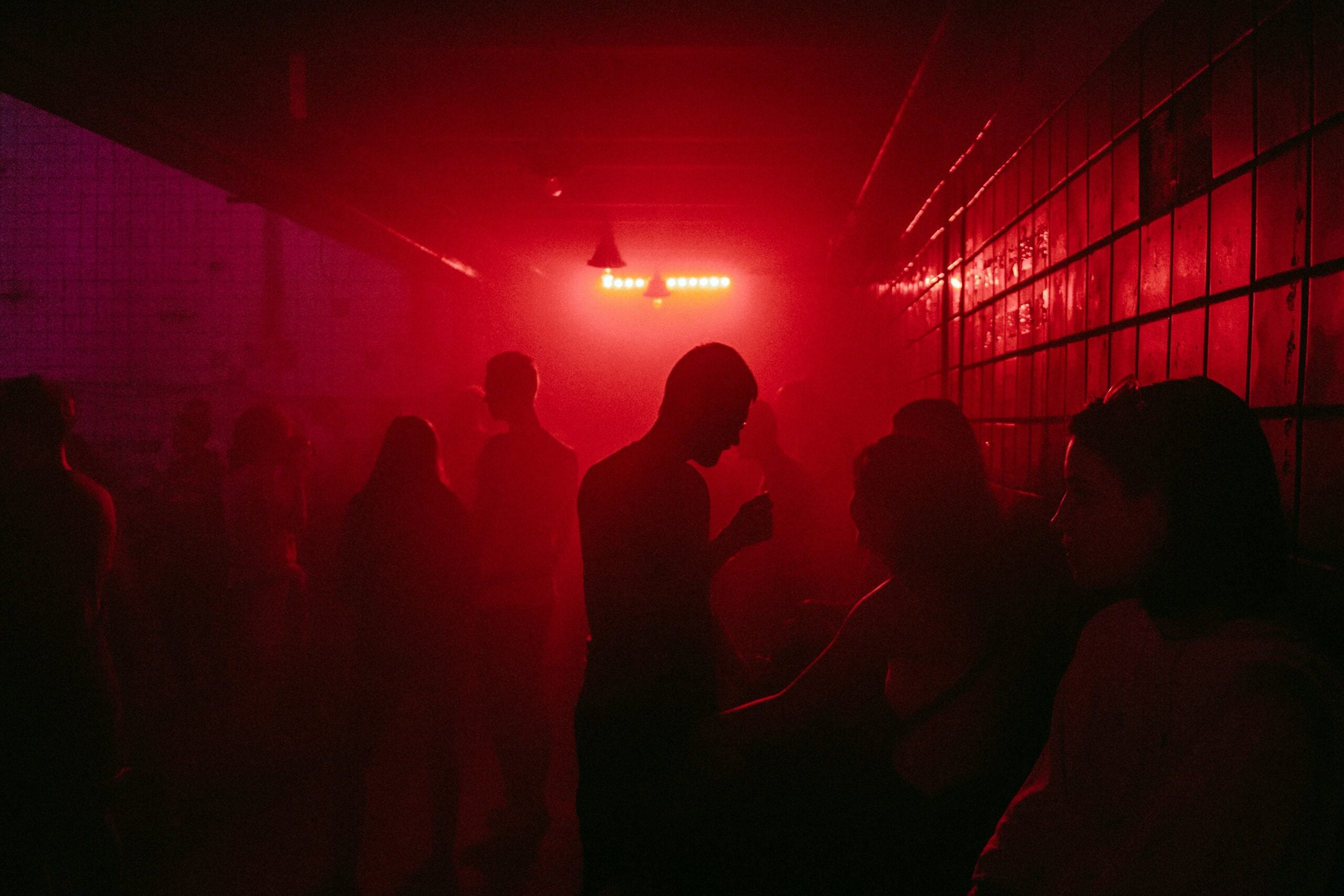
That sense of impermanence hangs over the whole place. Once inside, the space is inexplicably dark, with a series of serpentine corridors and staircases leading to unusual rooms. Even the walls can be toyed with, large chalk pieces left around the building let clubbers draw, write and depict their imagination in all corners of the building.
The place isn’t huge, but it does take time to explore the sheer maze of it – if anything because everyone around you is as confused and lost as you are. During our stint we came across a Sitar player, a heavy metal topless performer, some Brazilian funk DJ and even a secret unfinished damp room playing hardcore techno inside a minuscule room fitting no more than 8 people. There was even an actual cinema screening with popcorn stands and comfy arm-chairs.
And somehow, the clock ticked 4am.
Outside, Soho felt aggressively bright and oddly flat. I’m still not convinced I’m returning to weekly clubbing any time soon. But Lost reminded me that the problem was never the late nights — it was the predictability. It turns out I don’t hate clubbing. I just hate being bored.